
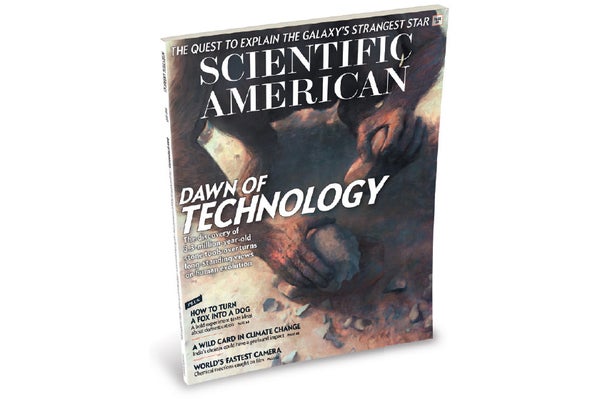
A number of animals employ existing objects to carry out certain tasks. Seagulls drop mollusks onto rocks to crack open a snack, for example. Corvids wield twigs to create insect-gathering hooks. Apes probe termite mounds with sticks. But humans have taken tool use to a level no other creature has ever matched. Technology innovation is so extensive that Michael Haslam of the University of Oxford has said, “It's like an addition to our bodies.”
In this issue's cover story, “The New Origins of Technology,” senior features editor Kate Wong investigates its surprisingly ancient beginnings. Recently Sonia Harmand and her husband, Jason Lewis, both at Stony Brook University, discovered 3.3-million-year-old tools at a site in Kenya called Lomekwi 3. The great age of the implements—far too early to be made by our own species, Homo—is forcing researchers to rethink what they believed they knew about the origins of technology and how incorporating tools into our existence has, in turn, shaped the human family tree.
Could alien technology be causing the mysterious dimming of Boyajian's star, also known as KIC 8462852, more than 1,000 light-years away from Earth? Probably not, write Kimberly Cartier and Jason T. Wright in their feature, “Strange News from Another Star.” Still, the two astronomers are among those who find it difficult to account for the dramatic and sporadic dimming with natural phenomena. Theorists posit exotic possible explanations, among them comet swarms or black holes. Beyond those is the intriguing possibility of an advanced cosmic civilization.
On supporting science journalism
If you're enjoying this article, consider supporting our award-winning journalism by subscribing. By purchasing a subscription you are helping to ensure the future of impactful stories about the discoveries and ideas shaping our world today.
Technology has its downsides, of course. Thousands of studies demonstrate that human activity, including the burning of fossil fuels, has led to global climate change. But how bad will it be? That's a question that will depend at least in part on the actions of a number of major emitters.
In “The Global Warming Wild Card,” Varun Sivaram, a fellow at the Council on Foreign Relations and acting director of its program on Energy Security and Climate Change, examines one wild-card country in our climate future: India. With its population and living standards rising quickly, India could prevent the world from limiting global warming to sought-for levels—or it could help make the difference in a better future. It is already the third-largest emitter after China and the U.S. but could become the largest by midcentury if it does not take strong measures. Can India make a low-carbon transition? Technical and financial support from other nations will be crucial.