
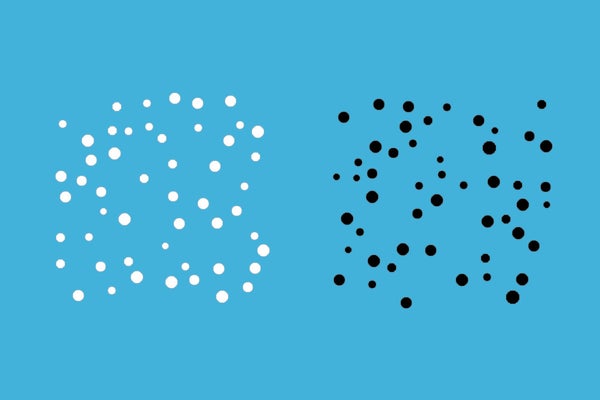
At a quick glance, could you tell the difference between a group of 20 dots and a group of 30? What about 20 and 21? It seems like there must be a point at which you'd simply be guessing, but recent research suggests otherwise.
Given enough opportunities, people consistently perform better than chance on this kind of task even when the numerical difference is extremely small, according to a study published in the Journal of Numerical Cognition.
“It's a very simple question with a really interesting answer,” says University of Pennsylvania psychologist Sami Yousif, who was not involved in the study. “I love very elegant, very simple results like this.”
On supporting science journalism
If you're enjoying this article, consider supporting our award-winning journalism by subscribing. By purchasing a subscription you are helping to ensure the future of impactful stories about the discoveries and ideas shaping our world today.
The research team showed more than 400 participants pairs of dot groups for just one second. On easy practice trials such as 30 versus 20 dots, participants chose the larger group correctly almost every time. For 20 versus 21 dots, they were right nearly 60 percent of the time. And even in the hardest comparison—50 versus 51 dots—participants consistently answered correctly on 51.3 percent of trials. It's a small but statistically significant difference, the researchers say.
“If you are asked to make a judgment about which of two groups contains more stuff, and you have a little bit of intuitive feeling that one of them is more than the other, you should trust your gut,” says study lead author Emily M. Sanford, a cognitive scientist now at the University of California, Berkeley.
The researchers tested two mathematical frameworks for thinking about this situation: one with a hard limit on the fine numerical differences people can perceive and one without. They found their data fit better with the limitless model, suggesting that even with numbers as high as 100 versus 101, the task would become harder but not impossible.
The implications go far beyond number sense, Sanford says, because the study builds on a theory describing perception across many different stimuli: the work suggests that when deciding which of two circles has a larger area, for example, a person wouldn't be truly guessing unless the circles were exactly the same size.
This theory predicts that with enough trials, an individual will perform above chance on even the hardest perceptual tasks. But there is intuitive appeal, even among some scientists in the field, to the idea that humans have a perceptual limit. “We can't tell that 51 is greater than 50, so we sort of forget that the perceptual system is doing that,” Yousif says. “I see it as a landmark paper in the sense that it really lays bare some of the assumptions that have, in my opinion, plagued this literature for a while.”