
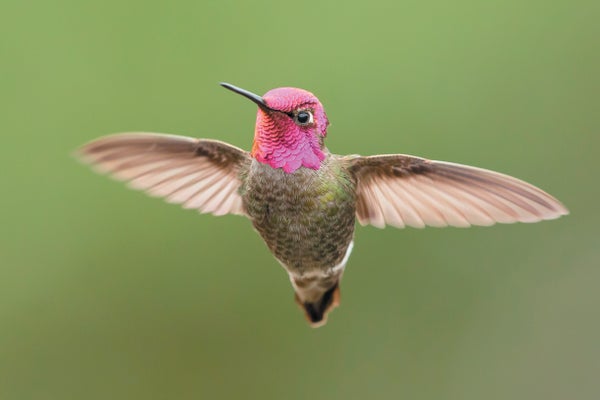
Hummingbirds are the Olympic gymnasts of the avian world. They zip around at remarkable speeds, hover in place and fly in all directions, including backward and while upside down. They can even perform flips.
To achieve such agility, hummingbirds use distinct modes of visual processing to control different types of flight, researchers report in the Proceedings of the Royal Society B. In particular, the scientists uncovered a seemingly unique mode that guides hummingbirds’ speed when they are flying forward.
The findings come from an analysis of more than 3,500 hummingbird flights inside a 12-foot-long tunnel with a perch at one end and a feeder at the other. Moving patterns projected on the tunnel walls manipulated the hummingbirds’ sense of optic flow—the perceived motion of surroundings while traveling through the world. The speed of that motion, called pattern velocity, is a key visual cue that many animals use to adjust their own speed and position as they move.
On supporting science journalism
If you're enjoying this article, consider supporting our award-winning journalism by subscribing. By purchasing a subscription you are helping to ensure the future of impactful stories about the discoveries and ideas shaping our world today.
The researchers expected that if the hummingbirds were using pattern velocity cues to control their forward flight speed, they would see the birds speed or slow in sync with vertical stripes projected on the side walls. But instead “it seemed more the case that they have their own internal speedometer or internal gauge” for forward flight, says study co-author Vikram Baliga, a comparative physiologist at the University of British Columbia.
Any movement that defied the hummingbirds’ expectations of how their surroundings should change slowed the birds down—even vertical stripes moving toward the feeder, which the researchers expected would make them speed up. When hovering or moving up or down, however, the birds based their motor commands on the projected patterns they saw.
The ability to switch between these different flight modes underlies a hummingbird’s singular agility, says study co-author Doug Altshuler, a zoologist at the University of British Columbia specializing in complex locomotion. Hummingbird brains have evolved to make rapid transitions from visual signals to motor outputs. “You watch them fly through the forest, and they’re dodging trees and moving branches in the wind—and each other,” he says. “They are adept at taking in lots of complicated visual information and making a robust and safe flight plan out of that.”
Further research will delve into the ways the birds predict how their movement will affect the flow of scenery around them. Understanding that could help engineers improve drone technology, says Bo Cheng, a mechanical engineer at Pennsylvania State University. “Can we develop a mathematical model for this prediction of optical flow?” Cheng asks. If so, “that could be very useful for drones.”