
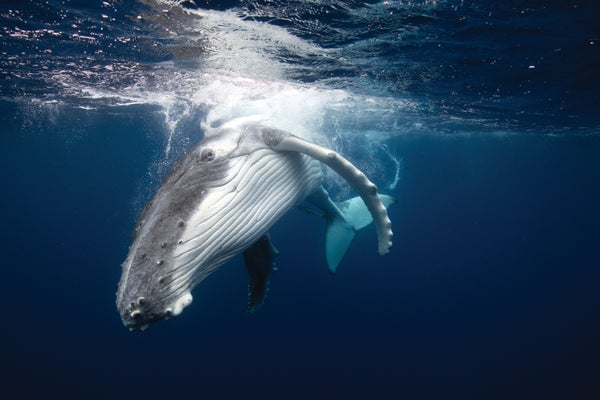
Recently coined words such as “selfie” and “hangry” reflect humans’ evolving language. The communication patterns of other social animals, including whales, also vary over time. The “songs” adult male humpback whales produce during the breeding season, for example, are constantly changing.
But in a new study, researchers investigated the permanence of nonsong whale vocalizations known as calls and found that the majority have remained stable over multiple decades. This surprising result suggests that calls may function as important tools for conveying information about foraging, social behaviors and whale identity.
Scientists have studied humpback whale songs extensively—but there is probably a lot more to these creatures’ communication than we know, says Michelle Fournet, a marine ecologist now at Cornell University and lead author of the new study. “The running hypothesis is that any time the whales are talking about something other than breeding, they’re using calls,” explains Fournet, who completed the work while at Oregon State University. These vocalizations, which typically last only a few seconds, are extremely diverse and have evocative names such as “moans,” “squeegies,” “shrieks” and “growls.” They can be heard by other whales several kilometers away.
On supporting science journalism
If you're enjoying this article, consider supporting our award-winning journalism by subscribing. By purchasing a subscription you are helping to ensure the future of impactful stories about the discoveries and ideas shaping our world today.
Fournet and her collaborators amassed nearly 115 hours of archival recordings collected in southeastern Alaska between 1976 and 2012. “No one had listened to them in years,” Fournet says of the older recordings, which likely include vocalizations of the great-grandmothers and great-grandfathers of juvenile whales alive today.
By analyzing the duration and frequency of the calls, the researchers grouped them into 16 types. Fournet and her team detected 12 of them in both the earliest and most recent recordings—and each of the 16 call types recurred over at least three decades, the scientists reported last September in Scientific Reports. This finding led Fournet to conclude that these particular vocalizations most likely are essential to the whales’ survival, ensuring foraging success and social contact. “For calls to stay in the [collective] conversation for so long is an indication that these call types are vital to the life histories of humpback whales,” she says.
This work provides “rare and very valuable insights into the evolution of animal communication systems,” says Volker Deecke, a biologist at the University of Cumbria in England, who was not involved in the research.
Next summer Fournet plans to travel to the southeastern Alaska to play back recordings of calls to humpbacks there. The goal is to test theories about the functions of different calls, she says, adding, "We're going to go and start the conversation."