
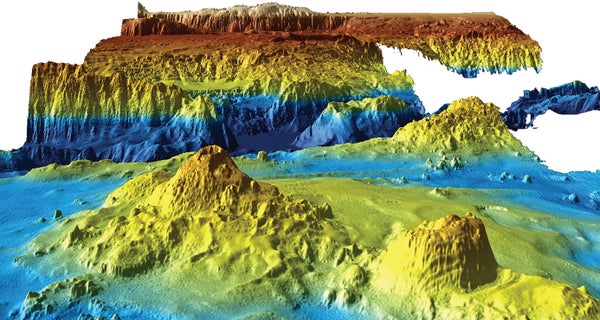
When a Malaysia Airlines flight vanished from the skies in 2014, initial reports characterized the massive undersea search area as mostly flat. But now the first scientific study to emerge from the hunt has revealed a little-explored region of great topographic complexity in the southeastern Indian Ocean. This area includes the point at which the Indian subcontinent and the Australian and Antarctic continents separated during the breakup of the supercontinent Gondwana. With 500 times the resolution of earlier satellite measurements, new maps have resolved formerly fuzzy pixels into well-defined features—strange ridges and “pockmarks,” as well as a vast plateau that ends in a steep escarpment notched with large landslides.
The new geophysical data, acquired using state-of-the-art shipboard sonar and published online earlier this year in Eos, span 2,500 kilometers of seabed. “This data set is clearly unprecedented in terms of the magnitude of the area surveyed and because it reveals a part of the deep ocean floor that had been largely unexplored,” says lead study author Kim Picard, a marine geoscientist at Geoscience Australia.
Geoscience Australia plans on releasing the first batch of data this month, with more to follow in mid-2018. Once the maps are made public, they will help researchers address ongoing puzzles in a region with a complex tectonic history. One mystery, says study co-author Millard Coffin, a marine geophysicist at the University of Tasmania, is an enigmatic seafloor texture called a spreading fabric—small, elongated ridges that generally parallel a rift in the seafloor where two plates are moving apart, allowing magma to rise. This phenomenon may have resulted from repeating pulses of volcanism along mid-ocean ridges, which previous research has linked to cycles of ice ages and warming. Investigations of these and other features may elucidate why seafloor spreading has been more complicated in the Indian Ocean than in the Atlantic, Coffin says. The improved resolution will also help scientists better understand many other deep-ocean processes, Picard explains, including landslides and pockmarks, craterlike features possibly caused by the escape of an unknown fluid or gas.
On supporting science journalism
If you're enjoying this article, consider supporting our award-winning journalism by subscribing. By purchasing a subscription you are helping to ensure the future of impactful stories about the discoveries and ideas shaping our world today.
The Malaysia Airlines tragedy was one of the cruelest and most wrenching in aviation history, with 239 people lost and a long international search that has failed to pinpoint clues or causes. But as Coffin notes, “much new knowledge about the deep seafloor is arising from it.”