
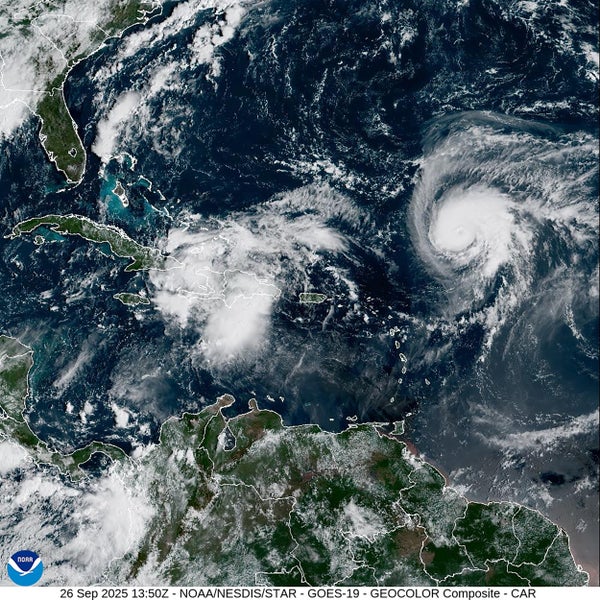
Editor’s Note (9/28/25): As of 2 P.M. EDT, Potential Tropical Cyclone Nine had become Tropical Storm Imelda in the western Bahamas when peak sustained wind speeds surpassed 39 miles per hour. The National Hurricane Center currently forecasts Imelda to head north, become a hurricane by early September 30, then turn eastward toward Bermuda. The storm could still bring tropical storm conditions to eastern Florida and flooding risks to the eastern Carolinas.
Meteorologists are carefully watching a volatile tropical cyclone situation in the Atlantic Ocean in the coming days that will determine whether the Carolinas will face potentially serious flooding early next week.
The uncertain hurricane forecast hinges on a storm system that is currently located over Cuba and the Bahamas. Dubbed Potential Tropical Cyclone Nine, it will become known as Tropical Storm Imelda if the system’s peak wind speeds reach 39 miles per hour. And as of 2 P.M. EDT on September 26, National Hurricane Center forecasters placed the probability of this occurring within the next 48 hours at 90 percent.
On supporting science journalism
If you're enjoying this article, consider supporting our award-winning journalism by subscribing. By purchasing a subscription you are helping to ensure the future of impactful stories about the discoveries and ideas shaping our world today.
But what would-be Tropical Storm Imelda might do once it achieves that status is much less certain—far less than usual. “There’s always inherent uncertainty at this point of a system,” says Alan Gerard, a meteorologist who runs the consulting company Balanced Weather and who served in leadership positions at the National Oceanic and Atmospheric Administration for more than 20 years. “This situation has a lot more complexity.”
That complexity is in part because of a second storm roiling the western Atlantic Ocean: Hurricane Humberto. With peak sustained wind speeds of 90 miles per hour, Humberto is currently a strong Category 2 hurricane and is expected to explode into a Category 3 hurricane overnight. This storm is currently moving west toward the Bahamas, although it is expected to veer north toward Bermuda before reaching the archipelago.
Having two concerning storm systems so close to each other isn’t common in the region. “It’s pretty unusual,” Gerard says. “It’s something you see more often in the West Pacific, where you just have more storms.”
Will We See the Fujiwhara Effect?
Because of the two storms’ proximity, experts are watching for the possible occurrence of an unusual phenomenon called the Fujiwhara effect. This phenomenon is named for Sakuhei Fujiwhara, a scientist who studied how vortices in fluid interact. The effect occurs when tropical cyclones come within about 850 miles of each other, although the distance at which it kicks in—and its end result—depends on the size of each storm.
“They could dance around each other, and if one hurricane is a lot stronger than the other, then the smaller one will orbit around the stronger one and eventually crash into the stronger one,” says Haiyan Jiang, an atmospheric scientist at Florida International University. “If the two hurricanes are closer in strength, they can just rotate around a common point.”
A recent example of the Fujiwhara effect occurred between Hurricanes Hilary and Irwin in the eastern Pacific in 2017; the storms eventually combined. And a rare Caribbean occurrence happened between Hurricanes Connie and Diane in 1955.
Whether Humberto and the possible storm Imelda experience the Fujiwhara effect remains to be seen. First, of course, Imelda must develop into a true cyclone rather than the mess of thunderstorms that it currently is. Then it’s a matter of the comparative speeds and directions of that storm and Humberto, Jiang says.
Forecasting in the Face of Uncertainty
Even if the storms remain too distant for the Fujiwhara effect to occur, they have already interacted, Gerard notes. On September 25 winds churned up by the developing system were caught up and blown toward Hurricane Humberto, where it became wind shear, a mess of wind that can tear apart a storm or slow its strengthening.
That sort of effect from what meteorologists call outflow could be a confounding factor as the situation unfolds because existing forecast models don’t re-create it realistically, Gerard says. “That certainly will be something that we’ll be watching pretty closely with these two systems,” he says.
The two storms could also influence each others’ paths, even without the Fujiwhara effect coming to pass, Gerard says. That’s because, as Humberto shifts to steer northeast, its effect on the atmosphere around it may leave a trail that could attract the would-be storm Imelda, keeping the latter away from the East Coast.
A key challenge of forecasting what will happen in the next couple of days is that the storm that could become Imelda does not yet have a clearly defined center around which winds rotate. Where the center develops will affect how the storm moves and reacts to the larger atmospheric environment around it. “Until we get a better handle on that, it’s hard to know which of these scenarios is more likely to occur,” Gerard says, noting that the system could develop a center by midday on September 27.
And even beyond the storms themselves, meteorologists face additional uncertainty in drawing up a forecast. That’s because of the atmospheric dynamics in the larger region, Gerard says: a pattern in the upper atmosphere over the East Coast is breaking up in an unpredictable way. How exactly this occurs will shape the way the atmosphere steers the developing storm.
To a degree, meteorologists simply need time to pass in order to develop a better sense of what these storms will bring. They’re also expecting data from research flights around the storm that could become Imelda, however, as well as from extra launches of weather balloons across the East Coast to understand the broader atmosphere.
“All of that combined should help us get a better picture,” Gerard says. “Hopefully, by the end of the weekend, we’ll have a much better expectation of what’s going to happen with all of this.”
In the meantime, meteorologists are already flagging that the developing storm system may push heavy rains ahead of it into the eastern Carolinas in what is formally dubbed a “predecessor rain event.” Such events can leave the ground waterlogged by the time a tropical cyclone’s rain arrives, making flooding more likely. The system may also approach the coastline as a Category 1 hurricane, forecasters worry.
Federal Shutdown Looms
Even as meteorologists wait to understand these systems better, the federal government seems to be racing toward a shutdown, which will occur on October 1 if congressional leaders cannot agree on a funding measure before then. Gerard worked for NOAA through several governmental shutdowns and worries what might happen if a shutdown and a threatening storm overlap.
In terms of what might directly affect the forecast, Gerard notes that if the system that could become Imelda advances slowly, meteorologists may need data from research flights in order to understand how it will behave—and it isn’t clear whether such flights would take off under a shutdown.
An additional concern is that reporting has suggested that President Donald Trump’s administration may use a federal shutdown to initiate broadscale “reductions in force,” as governmental layoffs are euphemistically dubbed.
“It could be a much more disruptive situation” than Gerard experienced during one active hurricane season he worked during a shutdown.
“It’s certainly not like everything just runs normally,” he says of shutdown operations. “The meteorologists will still be working; the forecasts will still be going out. But there will certainly be additional complications if it’s happening during a shutdown.”