
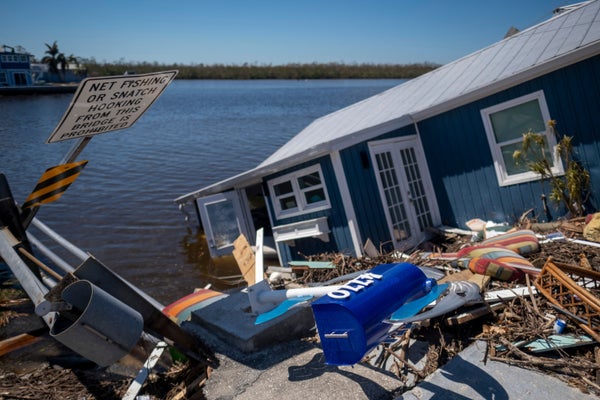
Hurricane Ian may have destroyed the financial security of thousands of Florida retirees whose life savings were invested in houses and condos lost to the storm’s winds and flooding.
Post-storm modeling from the analytics firm CoreLogic Inc. found that nearly 800,000 Florida homes saw hurricane force winds during the storm, with roughly 600,000 experiencing winds powerful enough to flatten a house.
The storm also had a disproportionate impact on older residents in some of the hardest-hit areas of the state, such as Lee and Collier counties, where nearly one in three residents is above age 65.
On supporting science journalism
If you're enjoying this article, consider supporting our award-winning journalism by subscribing. By purchasing a subscription you are helping to ensure the future of impactful stories about the discoveries and ideas shaping our world today.
According to U.S. Census data, 29 percent of the population of Lee County, where Ian made landfall, is of retirement age. In Collier County, immediately to the south, that figure rises to 33 percent.
Experts say the region’s senior boom, which began after World War II and has accelerated in recent decades, reflects Florida’s enduring appeal to retirees and snowbirds fleeing cold winter states. Florida also has no income tax and has lower housing prices per square foot than many other coastal states.
Southwestern Florida has seen some of the fastest and most concentrated growth among seniors, many of whom purchased homes with the expectation that Florida real estate values would hold steady or rise. With many of their homes now gone, the prospect of renting, building or buying new houses comes as the state faces surging prices for building materials, labor shortages and what is expected to be an acute housing shortage.
“So while we’re still tallying the aftermath … it appears Hurricane Ian has displaced thousands of Floridians whose homes are now uninhabitable, taking not only their shelter but their financial safety nets with it,” Pete Carroll of CoreLogic said at a webinar Thursday.
Initial modeling from CoreLogic showed Ian’s total property losses from wind and flood at between $40 billion and $70 billion.
Flood loss from insured residential and commercial properties were estimated between $8 billion and $18 billion, while uninsured property losses were between $10 billion and $17 billion, the analysis found. Wind losses, mostly concentrated in near-coastal communities, were estimated at between $23 billion and $35 billion.
For homeowners with federal flood insurance policies—which are required in the highest flood-risk areas based on FEMA flood maps—payouts for residential buildings are capped at $250,000, Carroll said. Yet mortgaged property owners in the hardest hit areas of Lee and Collier counties have an average $316,500 in home equity.
Selma Hepp, the interim lead of CoreLogic’s chief economist’s office, said in a blog post last week that post-storm disruptions to Florida housing markets will be substantial and could last for months and even years.
“Initially, we are likely to see an increase in mortgage delinquencies as is typical following catastrophes,” Hepp said. “Also, rents are likely to jump as households who lost their home seek immediate shelter."
“Longer-term home price growth in hard-hit areas is likely to lag that of the rest of the state and nation as people may opt to move to areas less prone to natural disasters,” she added.
Gladys Cook, director of resilience and disaster recovery for the Florida Housing Coalition, said senior citizens account for a substantial share of low- and middle-income residents who depend on affordable housing. Many of those residents are “just going back home to family or they might be leaving Florida,” she said in a phone interview.
Cook, who lived in Lee County for 30 years, said she believes the number of seniors affected by the hurricane could be much higher than early estimates indicate.
“This loss is extraordinary,” she said. “It’s just going to take years to catch up with housing for all of those people.”
Reprinted from E&E News with permission from POLITICO, LLC. Copyright 2022. E&E News provides essential news for energy and environment professionals.