
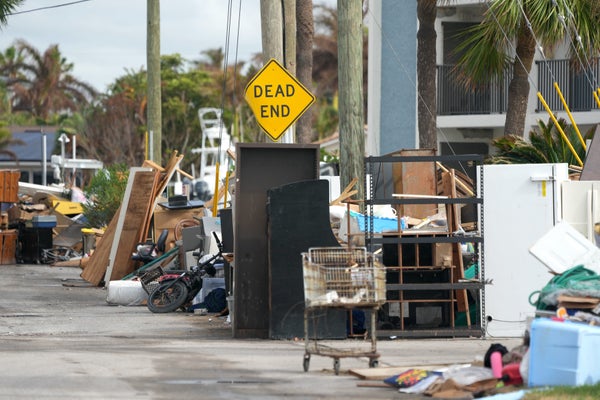
CLIMATEWIRE | As Florida prepares for Hurricane Milton’s violent winds and massive flooding, the state also is contending with a unique danger — debris left by Hurricane Helene that officials fear will become lethal or damaging missiles.
Florida is taking unprecedented steps to clear streets and parks of appliances, furniture, splintered houses and tree limbs before the arrival of Milton, which is projected to hit the Tampa area on Wednesday evening as a Category 4 storm.
“We’ve just got to get the debris gone so those do not become projectiles when this storm makes landfall,” Florida Chief Financial Officer Jimmy Patronis said in a TV interview Tuesday referring to Hurricane Milton.
On supporting science journalism
If you're enjoying this article, consider supporting our award-winning journalism by subscribing. By purchasing a subscription you are helping to ensure the future of impactful stories about the discoveries and ideas shaping our world today.
Gov. Ron DeSantis has ordered local landfills to remain open around the clock, over the objections of some local officials. Florida Highway Patrol drones are helping cleanup crews in the Tampa Bay area. The state Department of Environmental Protection has given emergency authorization for the establishment of 218 temporary debris-storage sites.
Tropicana Field, a domed stadium in St. Petersburg where the Tampa Bay Rays play baseball, is being converted to a base camp for debris removal and other hurricane-related activities.
The Florida Department of Transportation has used its own trucks in recent days to remove 175,000 cubic yards of Helene-related debris from public areas — enough to fill nearly 2,000 swimming pools.
“We have been laser-focused on the debris mission,” FDOT Secretary Jared Perdue said Tuesday during a news briefing. “We’re going to continue picking up debris, taking it to landfills until it’s no longer safe.”
On Tuesday, Florida officials said they will ask the Biden administration to approve using federal disaster aid to pay trash haulers financial incentives that are more lucrative than a fee based on the size of a haul.
“Why would you come from Arizona or California under the current incentive?” DeSantis said.
Trash haulers operating in Florida are receiving police escorts and cheers from onlookers.
“They’re thankful for this because it just shows progress,” DeSantis said.
As it becomes clear that haulers will not come close to clearing all the debris from Helene, officials in the Tampa Bay area have told residents to keep damaged belongings in their homes during Milton and not place them on the street for pickup, according to the Tampa Bay Times.
Debris cleanup is one of the most difficult and costly aspects of disaster recovery, taking months and tens millions of dollars to complete.
States have spent a total of $24 billion removing debris after major disasters since 1998, according to an E&E News analysis of federal records. The Federal Emergency Management Agency has paid $21 billion of the cost, which is about $5 billion more than FEMA has spent helping repair roads and bridges.
Florida has spent $5.5 billion on debris removal after major disasters since 1998, more than California and Texas combined and far more than any other state.
But Hurricane Milton has created a unique and dangerous situation because of its arrival shortly after Hurricane Helene.
“Most times after a storm, you don’t have another storm on the back end. These things tend to take months and months to be able to do,” DeSantis said of debris removal.
Although state officials are urging trash haulers to work around the clock, as state agencies are doing, “most are not doing 24/7,” DeSantis said. “The only place that has really had the sense of urgency is Jared [Perdue] and the FDOT.”
Patronis, the financial officer, said, “There’s been some challenges between the contractors and FEMA.”
FEMA typically pays 75 percent of debris-removal costs after a disaster and leaves state or local governments to pay the remaining 25 percent. After Helene, President Joe Biden agreed to pay 100 percent of cleanup costs in Florida and the five other states that he declared a major disaster.
Biden’s decision could save Florida taxpayers hundreds of millions of dollars.
But Florida officials are concerned that FEMA pays for debris removal using a rate for each cubic yard hauled.
“If they’re only guaranteed, say, $9 a cubic yard, there’s not really an incentive for them to get on the road and travel three days across the country to get here,” said Kevin Guthrie, executive director of the Florida Division of Emergency Management.
Guthrie said Tuesday that they will ask FEMA to pay trash haulers a predetermined daily rate over 30 to 90 days.
“We want to be able to guarantee individuals, say, from California, Texas, the Midwest to come to Florida,” Guthrie said.
Reprinted from E&E News with permission from POLITICO, LLC. Copyright 2024. E&E News provides essential news for energy and environment professionals.