
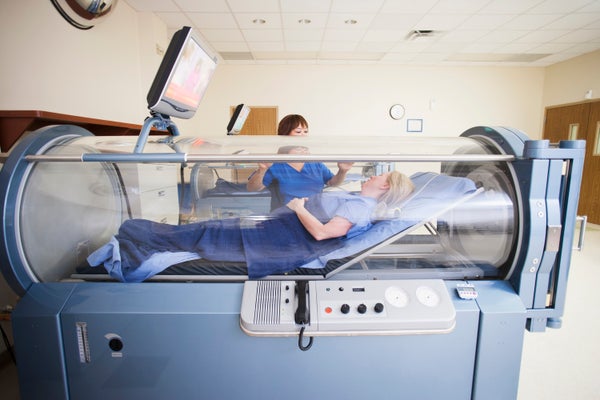
M. Martinez had been living with long COVID for 18 months when he was referred to emergency medicine specialist Craig Lindsey’s hyperbaric center in Santa Fe, N.M. A 49-year-old court professional, Martinez (first name withheld for privacy) had become so cognitively impaired that he could no longer work full-time or drive, and he feared he might have to move into a memory care facility.
But after eight weeks of hyperbaric oxygen therapy (HBOT)—a treatment that involves breathing pure oxygen under elevated pressure in a specialized chamber—two thirds of his neurocognitive test scores returned to the normal range, and he resumed working and driving.
Stories like Martinez’s are fueling interest in HBOT as a treatment for long COVID, a broad constellation of symptoms, including brain fog and debilitating fatigue that affects millions of people worldwide and has no clear remedy.
On supporting science journalism
If you're enjoying this article, consider supporting our award-winning journalism by subscribing. By purchasing a subscription you are helping to ensure the future of impactful stories about the discoveries and ideas shaping our world today.
HBOT is proven to help heal several medical conditions including decompression sickness from diving (aka “the bends”), carbon monoxide poisoning and diabetic wounds. But the evidence for HBOT as a long COVID treatment is mixed.
Proposed Mechanisms
Several biologically plausible mechanisms for hyperbaric therapy’s effects on long COVID have been proposed, although none have been proven.
Some people with long COVID appear to have difficulty extracting oxygen at the tissue level, possibly as a result of thickened membranes in capillaries. HBOT may compensate for this by forcing more oxygen to dissolve in the blood.
Long COVID is also linked with blood clotting, chronic inflammation and malfunctioning mitochondria, the tiny engines that power our cells. Proponents of HBOT argue that it works by reducing the blood vessel lining problems that trigger clotting, stimulating new blood vessel growth, tamping down inflammatory molecules called cytokines and helping mitochondria function better.
HBOT may also trigger the release of growth factors such as brain-derived neurotrophic factor, potentially helping repair neurons in long COVID patients with neuroinflammation.
A Mixed Evidence Base
The clinical evidence is promising but inconsistent. A placebo-controlled phase 2 randomized trial of HBOT involving 73 long COVID patients at Shamir Medical Center in Israel found lasting improvements in cognition, energy, and sleep. Participants underwent daily sessions for 40 days over the course of two months, and in a follow-up study, the benefits lasted for at least a year. But a subsequent Swedish trial of 80 subjects showed no advantage over placebo treatment; that protocol used only 10 sessions over six weeks, however. “These treatments are really meant to be a Monday-through-Friday daily session,” says Lindsey, who was not involved in either study. “That’s where you get the benefit.”
Long COVID could arise from a wide range of underlying mechanisms, from viral persistence to immune dysregulation to vascular damage, and different people may “need vastly different treatments,” says David Putrino, a professor of rehabilitation and human performance at the Icahn School of Medicine at Mount Sinai in New York City, who was not involved in the trials. HBOT may be most appropriate for long COVID patients with vascular dysfunction or neuroinflammation, but “more studies are needed to figure out which [type of patient] will have the most benefit at what dosage,” says Monica Verduzco-Gutierrez, who directs the multidisciplinary long COVID clinic at UT Health San Antonio.
While the therapy appears acceptably safe in controlled trials, “it should not be considered risk‑free,” says Mark Faghy, a professor of clinical exercise physiology at Loughborough University in England. A study of long COVID patients in the Netherlands found that while 56 to 63 percent of them reported meaningful quality-of-life improvements after HBOT, 13 to 19 percent saw their mental or physical health deteriorate.
People with postexertional malaise, the worsening of symptoms following even minor physical or mental exertion, may be at a higher risk for adverse effects from the therapy, Faghy and Putrino point out. The treatment requires patients to be enclosed in a high‑pressure chamber, where they must breathe against that pressure, for 90 minutes a day. “If your patients are not carefully selected, you can cause more harm than good by exerting them to that degree,” Putrino says.
HBOT can also lead to tissue damage caused by pressure differences and poses a fire risk, especially if not done by clinicians specifically trained in hyperbaric medicine. Hyperbaric chambers at unregulated “medical spas” are often run at pressures too low to be effective, and these spas are staffed by people who “are not certified, and that makes it dangerous as well as ineffective,” Lindsey warns.
Barriers to Access
Neither the U.S. Food and Drug Administration nor the Undersea and Hyperbaric Medical Society (UHMS), which accredits hyperbaric oxygen facilities, recognize long COVID as an approved use for HBOT yet. But the American Academy of Physical Medicine and Rehabilitation lists HBOT as an emerging therapy for long COVID.
HBOT faces steep obstacles to being widely adopted. Lindell Weaver, a hyperbaric medicine specialist, who has led phase 2 trials testing HBOT for traumatic brain injury, says that U.S. insurers and Medicare are unlikely to cover HBOT for long COVID and brain injury without large, phase 3 trials run under FDA rules. At the moment, no one is funding such trials.
Unless insurance covers HBOT, the therapy will remain out of reach for most people. Hospitals bill roughly $5,000 per session; a full 40-session course runs to $200,000. “This creates significant equity concerns, as access is largely limited to people who can afford to self-fund treatment,” Faghy says.
There are logistical challenges too. “These are big devices that take up a lot of space,” Putrino says. And in the U.S., there are only about 1,000 hospital-based hyperbaric facilities—nowhere near enough to serve the millions of people living with long COVID, Lindsey says.
Sandra Wainwright, a hyperbaric physician in the Yale New Haven Health System and incoming president of UHMS, plans to form a committee to systematically review the evidence for the therapy’s new brain-related indications, including long COVID. She is optimistic that UHMS may act sooner than the FDA, but even with UHMS endorsement, widespread insurance coverage could be five to 10 years away, she says.
For now, Verduzco-Gutierrez says, the therapy will probably remain a supplementary option “for those who have the financial resources for it.”