
August 1967
Efficient Agriculture
“The fact that the production of food and fiber engages only 5 percent of the U.S. labor force is primarily due to the mechanization of farming. Other technological developments—chemical fertilizers, pesticides, plant breeding and so on—make essential contributions, but mechanization is still the outstanding factor. The picking and winnowing of a crop usually accounts for at least half of the total cost of production. It is also by far the most difficult part of the agricultural process to mechanize. Nevertheless, the mechanization of harvesting in the U.S. has made such strides that, in spite of the costliness of the machines and other technical aids, the cost of food to American families, in terms of its percentage (18 percent) of their income, is the lowest in the world.”
On supporting science journalism
If you're enjoying this article, consider supporting our award-winning journalism by subscribing. By purchasing a subscription you are helping to ensure the future of impactful stories about the discoveries and ideas shaping our world today.
Department of Agriculture figures from 2015 show the proportion of family food spending in the U.S. was still the lowest.
Does the Ocean Floor Spread?
“The hypothesis that the floor of the oceans has been spreading seeks to explain some characteristics of ocean basins and the continents by supposing that material welling up from the interior of the earth forms mid-ocean ridges and then, as new material rises, moves outward, away from the ridges. The hypothesis has been strengthened recently by the discovery that bands of alternating normal and reversed magnetism parallel the mid-ocean ridges, apparently indicating upwellings of molten rock during different magnetic 'polarity epochs.'”
August 1917
Protecting Wildflowers
“For the past fifteen years a few Nature-lovers have been carrying on in this country an earnest campaign on behalf of the preservation of our native wildflowers and other wild plants. According to a review of these efforts published by Mrs. Elizabeth Britton in the American Museum Journal, some of the plants that stand in most urgent need of protection are now nearly extinct in many parts of the country where they were once common. The preservation movement began in 1901 with a fund of $3,000 to be used for 'investigation and preservation of our native plants.' The Wild Flower Preservation Society of America now has chapters in several cities. The fund secures essays, leaflets, posters and lantern-slides for illustrated lectures in schools and colleges.”
Britton had also helped establish the New York Botanical Garden in 1891.
Cable Car for Freight
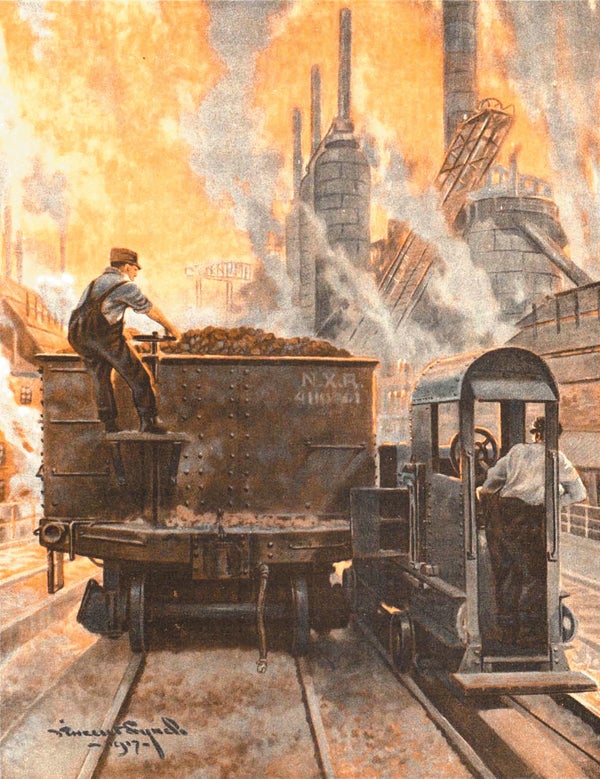
“The expeditious handling and quick-unloading of freight cars today is a most important factor in industrial war mobilization, particularly in handling iron ore at the docks. A new type of car pusher for the purpose of speeding up the unloading of cargoes and cars and eliminating the necessity of a switch engine is shown in the illustration. The pusher is propelled by a single cable, which runs between the rails the full length of the dock. The cable is securely anchored to concrete foundations at both ends through a spring tension device, which keeps it taut.”
August 1867
Teaching Dentistry
“Forty years ago surgeons and doctors generally officiated as teeth-pullers whenever occasion demanded. In 1820 there were but 30 practicing dentists in the United States. In 1850 the number had increased to 2,923, and at present there are about 5,000. A college for the education of those desiring to enter this profession has been established over a year in this city [now the N.Y.U. College of Dentistry], and the faculty of Harvard College, at their last Commencement, provided for a department of dentistry.”
A Disgrace to Civic Pride
“Without an exception, the New York markets are a disgrace to the city and discreditable to the enterprise of our people. It is surprising that such dirty, inconvenient, and disgraceful shams as our markets, are not supplanted by structures which would be creditable to American enterprise. Buildings might be erected in place of the tumble-down shanties now dignified with the name of markets, which would be not only objects of pride as architectural structures, but be made sources of revenue. Few public improvements are more needed in New York City than market-houses, which are at the present, literally a stench in the nostrils of the people.”
