
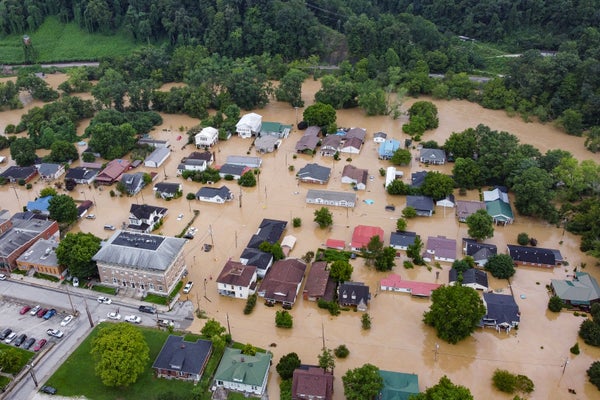
Homebuyers nationwide are ignoring flood risk and paying inflated prices to create a housing bubble that could crash as climate change intensifies flood damage.
A study released Thursday says the climate-driven housing bubble threatens homeowners with plummeting values and municipal governments with losing a big chunk of tax revenue if local property values fall.
The U.S. real estate market fails to account for flood risk because many homebuyers deny climate change and government practices leave homeowners unaware of the potential dangers of inundation, according to the paper in Nature Climate Change.
On supporting science journalism
If you're enjoying this article, consider supporting our award-winning journalism by subscribing. By purchasing a subscription you are helping to ensure the future of impactful stories about the discoveries and ideas shaping our world today.
The study, which builds on previous research about climate change and inflated housing prices, points to shortcomings in public policy, including federal flood maps that fail to identify millions of flood-prone properties, the absence of state laws requiring home sellers to disclose flood risk and underpriced federal flood insurance.
The lack of information combined with skepticism about climate change leads homebuyers to pay inflated prices that don’t account for the costs of flood insurance or flood repairs.
“The market is not capturing all these future losses projected to impact these properties right now,” said Carolyn Kousky, a study author and associate vice president for economics and policy at the Environmental Defense Fund. “At some point, there needs to be a market correction.”
Kousky added that “if the market corrects itself and sees decreases in values, homeowners are going to experience that as a loss.”
The study finds that U.S. properties are overvalued by between $121 billion and $237 billion — a much higher figure than previous estimates. Home prices are inflated in almost every county in the U.S.
Some of the highest rates of overvaluation are in counties in Kentucky and West Virginia, the study shows.
“When you take property values out of the equation and consider overvalue relative to value, Appalachia really emerges as a hot spot. That’s an area where there are high flood risks and the costs are currently poorly capitalized,” said study author Jesse Gourevitch, a postdoctoral fellow at the Environmental Defense Fund.
In Letcher County, Ky., home prices are 42 percent above where they would be if homebuyers accounted for flood risk, the researchers say. That’s the highest rate in the country.
Fourteen of the 20 counties with the highest rate of overvaluations are in Kentucky or West Virginia, the study shows.
The counties with the largest overvaluation in terms of dollars are overwhelmingly on the Florida coast. In Broward County, Fla., just north of Miami, properties are overvalued by $6.8 billion, which is the most of any county.
Twelve of the 20 counties with the highest amount of overvaluation are in Florida.
The study says that the vast number of overvalued properties are “concentrated in counties along the coast with no flood-risk disclosure laws and where there is less concern about climate change.”
Many of the nation’s overvalued properties are outside of the Federal Emergency Management Agency’s designated flood zones but face substantial risk nonetheless. The study highlighted “deficiencies in FEMA maps” that are supposed to delineate areas with the largest flood risk.
Florida has gained notoriety among some climate advocates because it is one of about 20 states that does not require home sellers to disclose any information about their properties' flood risk or flood history.
The study authors outline four possible scenarios for the housing market.
In a “market crash” scenario, real estate prices in flood zones plummet as many residents move away and default on their mortgages. Several factors could cause a market crash including more states adopting laws requiring flood disclosure during real estate sales and mortgage interest rates becoming more expensive in flood zones.
A “soft landing” scenario involves similar causes and consequences but on a more gradual scale.
In a “business-as-usual” scenario, developers continue to build in flood zones and mortgage lenders continue to absorb flood risks without passing them on to borrowers.
The “damage reduction” scenario envisions decreasing flood damage to homes as the government builds flood protection systems such as levees and pays residents to move away from flood zones.
"In any of these scenarios, policymakers will have to be making tradeoffs about who’s bearing the cost of climate change and whether it’s property owners or American taxpayers more generally,” said Gourevitch, the study author. “That’s a really challenging question.”
Reprinted from E&E News with permission from POLITICO, LLC. Copyright 2023. E&E News provides essential news for energy and environment professionals.