
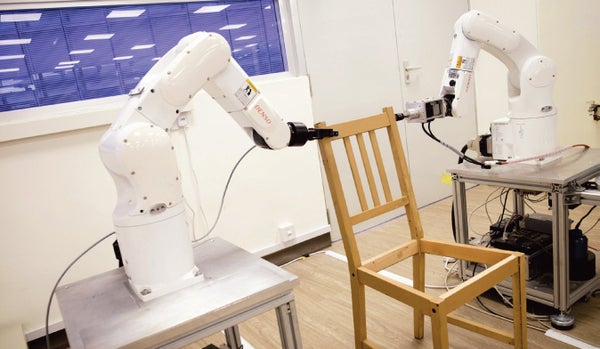
Anyone who has spent an afternoon puzzling over IKEA furniture parts will appreciate how tempting it would be to let a robot do the job. The Swedish company's complex DIY kits are something of a benchmark for roboticists, who have worked for years to build automatons smart and dexterous enough to fit screws and wood pegs into holes.
Engineers at Nanyang Technological University in Singapore have now assembled a STEFAN chair using a two-armed robot, whose sensors and programming enabled it to fit most of the pieces together without human help. The team reported its feat in April in Science Robotics. Using its arms, parallel grippers, sensors and 3-D camera, the machine followed about 50 steps of instructions to complete the chair's frame in about 20 minutes.
Furthermore, the robot was made of off-the-shelf parts that “are already mass-produced, so the technology we developed here can be deployed in actual factories in the very near future,” says Quang-Cuong Pham, an assistant professor of mechanical and aerospace engineering, who built the robot with Francisco Suárez-Ruiz and Xian Zhou, both then at Nanyang.
On supporting science journalism
If you're enjoying this article, consider supporting our award-winning journalism by subscribing. By purchasing a subscription you are helping to ensure the future of impactful stories about the discoveries and ideas shaping our world today.
The engineers programmed the robot using conventional computer code instead of training the device to assemble parts via machine learning. They focused on the robot's perception, planning and control capabilities rather than the more abstract reasoning enabled by artificial intelligence, Pham says.
The robot's arm movements may look slow and tedious, but its ability to fit pegs into holes addresses “a superhard problem in robotics,” says Ross Knepper, an assistant computer science professor at Cornell University, who was not involved in the Nanyang research. Knepper was part of a Massachusetts Institute of Technology team that in 2013 built the “IkeaBot” system of autonomous robots, which successfully assembled the furniture company's LACK side tables.
“Whereas my work used vision to solve the peg-in-a-hole problem, the Nanyang researchers are doing it through tactile feedback—feeling whether or not the peg went into the hole,” Knepper says. “The applications [of these two approaches] are both for IKEA furniture, but the contributions to robotics are very different.”
The Nanyang team's technology is meant to be reprogrammable for different tasks—including possibly assembling other kinds of furniture. “The dream,” Knepper says, “is still to have one robot system that can assemble IKEA's entire catalog—but we're not there yet.”