
January 1968
The Weakness of Polls
“A strong caution against attaching too much weight to polls of public opinion, particularly concerning political issues, has been expressed by Leo Bogart, president of the American Association for Public Opinion Research. ‘“Don't know” in response to a survey question,’ he writes, ‘often means “Don't want to know,” which is another way of saying, “I don't want to get involved.”’ In many such cases the attitude reflects the respondent's feeling that the issue is no responsibility of his. Bogart sees a valuable role for surveys in ascertaining the extent of public ignorance on matters of fact. ‘Often what we should be doing ... is measuring the degrees of apathy, indecision or conflict on the part of the great majority, with the opinionated as the residual left over.’”
On supporting science journalism
If you're enjoying this article, consider supporting our award-winning journalism by subscribing. By purchasing a subscription you are helping to ensure the future of impactful stories about the discoveries and ideas shaping our world today.
January 1918
Gods of Egypt
“The question of the character and origin of the local gods of Egypt is still obscure; but a paper by Prof. Flinders Petrie does much to clear it up. By marking the headquarters of each deity, he arrives at important results. Ra appears in only one southern city, and his cult seems to have come from the north-east. The distribution of Mut, the mother-goddess, is decidedly eastern, while that of Amen is western. Set was certainly brought into Egypt by the desert road, as he had there two centers of the first class, and he was introduced by the Red Sea way to the Eastern Delta. The distribution of the Osiride triad indicates a settlement so early in the land that the worship was generally diffused.”
Auto Dreams
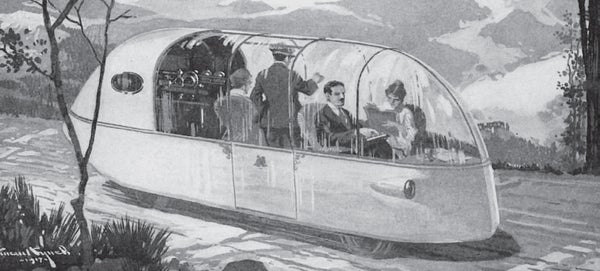
“It's more or less true—no one really knows anything about the future. So here goes, for a try. The automobile of the future will be weather-tight. Probably it will be all glass—sides, front, rear and roof. If malleable glass is ever made, the frame may be dispensed with, but nobody has discovered malleable glass, to date! In the future the car with the steering wheel will be as obsolete as the car with the hand pump for gas or oil is today! Driving will be done from a small control board, which can be held in the lap. It will be connected to the mechanism by a flexible electric cable. A small finger lever, not a wheel, will guide the car.”
Whale Steak
“I have joined with the crowd in another attempt to shoot a torpedo into the ribs of the high cost of living. Let me tell you that from an epicurean standpoint, whale meat isn't so awful bad. It is better than crow, not so tough as alligator, nor so rank as buzzard. Buzzard? ‘Yes, stew it with red pepper and lots of garlic and you can never tell.’ This is particularly true if the pepper is of the Mexican variety—real hot. The University of California and several other institutions of wise heads are attesting to the value of whale beef for food, but its own cheapness, 12 cents a pound, is the best drawing card.”
January 1868
Killing the Vector
“Dispatches from Commander Chandler of the United States steamer Don, dated Vera Cruz, Dec. 16, state that the yellow fever broke out on board of his vessel on the 25th of November. It proved to be of a most malignant type. Commander Chandler caused the hatches of the berth-deck and ward-room to be securely closed. One joint of the steam-heater on the berth-deck was disconnected, and the same operation performed in the ward-room. After two hours' steaming in the ward-room, a thermometer indicated 205 degrees, and on the berth-deck 170 degrees. No cases of fever occurred afterward. Commander Chandler is fully persuaded that heat eradicated the disease as effectually as a severe frost could have done.”
Yellow fever was not definitively shown to be transmitted by mosquitoes for another three decades.
Rubber Tire Invented
“Mr. R. W. Thomson, of Edinburgh, has invented a new locomotive for common roads, which was lately tried in the neighborhood of Edinburgh. The tires are made of bands of vulcanized india-rubber, about twelve inches wide and five inches thick. Incredible as it may appear, this soft and elastic substance not only carries the great weight of the road steamer without injury, but it passes over newly broken road metal, broken flints, and all kinds of sharp things without leaving even a mark on the india-rubber. The engine is destined for Java.”
