
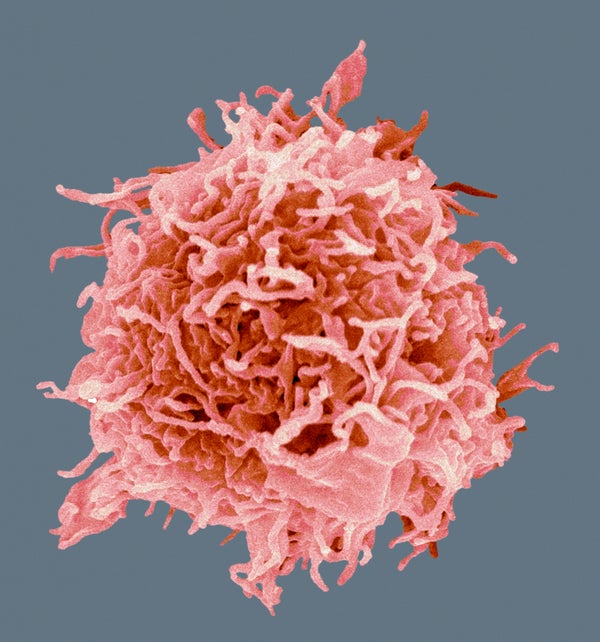
Two scientists who discovered the roles of key immune cells have won one of the 2019 Lasker medical-research awards—prizes often dubbed the American Nobels.
Immunologists Jacques Miller, at the Walter and Eliza Hall Institute of Medical Research in Melbourne, Australia, and Max Cooper, at Emory University in Atlanta, Georgia, will split the US$250,000 prize for basic medical research.
The duo identified T and B cells, which are key components in the immune system’s ability to recognize specific pathogens and cancer cells. B cells produce antibodies—proteins that can recognize the molecular signatures of pathogens. T cells form a key defence against virus-infected cells and cancer cells.
On supporting science journalism
If you're enjoying this article, consider supporting our award-winning journalism by subscribing. By purchasing a subscription you are helping to ensure the future of impactful stories about the discoveries and ideas shaping our world today.
Miller, working at the University of London in the late 1950s and 1960s, identified a population of immune cells that develop in the thymus gland of mice—called T lymphocytes or T cells. He showed that mice lacking a thymus—an organ that had no apparent function in adult animals—were prone to infection and did not reject skin grafts from other rodents.
Cooper built on Miller’s discovery while at the University of Minnesota in Minneapolis in the 1960s. He determined that cells produced in an organ found in birds—called the bursa of Fabricius—were responsible for antibody production, and that their development was distinct from that of T cells. Cooper and others later showed that humans and other mammals produce these B lymphocytes, or B cells, in their bone marrow.
Antibody breakthrough
Because antibodies have the ability to recognize—and block—almost any molecule, some antibody proteins have been successfully developed into medicines. Three scientists who helped to develop an antibody drug used to treat certain breast cancers are winners of this year’s Lasker-DeBakey Clinical Medical Research Award.
H. Michael Shepard and Axel Ullrich—then at the biotechnology firm Genentech in South San Francisco, California—worked with Dennis Slamon, an oncologist at the University of California, Los Angeles, to create the drug Herceptin. It was the first ‘monoclonal’ antibody treatment developed to block a cancer-causing protein called HER2. Ullrich was one of several to independently identify the HER2 gene, and he and Shepard investigated its cancer-causing effects. Slamon, meanwhile, showed that some breast tumours had extra copies of the HER2 gene and overproduced its protein product. (Ullrich is now at the Max Planck Institute of Biochemistry in Martinsried, Germany, and Shepard at Biooncology Consultants in San Diego, California.)
A third prize, the 2019 Lasker-Bloomberg Public Service Award, was given to Gavi, the Vaccine Alliance. The non-governmental organization in Geneva, Switzerland, raises funds to pay for vaccines in low- and middle-income countries. The organization has helped to vaccinate 760 million children in 73 countries. Last month, it launched a $7.4-billion fundraising drive, with the aim of immunizing 300 million people by 2025.
This article is reproduced with permission and was first published on September 10, 2019.