
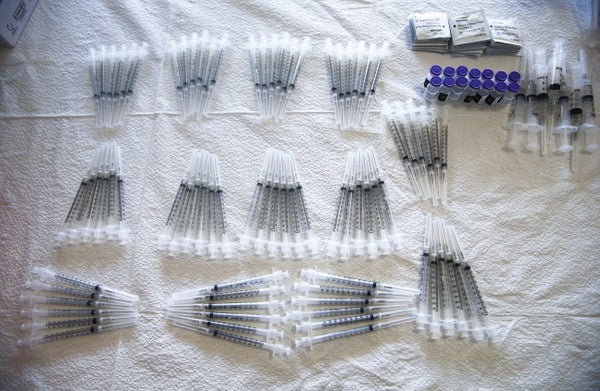
In a historic move, the US government has announced that it supports waiving patent protections for COVID-19 vaccines, a measure aimed at boosting supplies so that people around the world can get the shots. “The extraordinary circumstances of the COVID-19 pandemic call for extraordinary measures,” said US trade representative Katherine Tai in a statement.
The move came on 5 May, the first of a two-day meeting of the general council of the World Trade Organization, based in Geneva, Switzerland. Until now, the United States, the European Union, the United Kingdom and Japan have blocked efforts brought by India and South Africa to make it legal to manufacture generic versions of COVID-19 vaccines.
Former US presidents from both the Republican and the Democratic parties have staunchly defended intellectual-property rights, so the move by the administration of President Joe Biden has shocked people on both sides of the debate. “This marks a major shift in US policy in a pro-public-health way,” says Matthew Kavanagh, a global-health researcher at Georgetown University in Washington DC.
Kavanagh is part of the growing chorus of health-policy and global-health researchers advocating patent waivers, as the gap between vaccination rates in rich and poor nations grows larger every day. Fewer than 1% of people in low-income countries have received COVID-19 vaccines. The researchers are quick to note, however, that a waiver on patents covering all aspects of COVID-19 vaccines would be just the first step in ramping up vaccine supply.
First step of three
“It’s a one-two-three,” explains Rachel Cohen, US director for the non-profit Drugs and Neglected Diseases initiative in New York City. “First we need to remove patent obstacles, second we need to transfer the knowledge on how to make them, and step three is a massive investment in manufacturing capacity.”
And at the moment, step one is far from complete. The World Trade Organization will not negotiate the details of which patents to adjust until all its member countries agree on some sort of waiver. Health-policy analysts speculate that other countries will follow in the footsteps of the United States, although the European Union might hold out beyond the end of the meeting. South Africa and India have proposed waivers on patents, not only on vaccines, but also on COVID-19-related medical devices, drugs and diagnostic technologies; so far, Tai’s statement mentions only vaccines.
Drugmakers and others who oppose the measure say that waivers sabotage companies’ enormous investments in drug and vaccine development, which are compensated by their ability to set the price on products that they exclusively own. Normally, patents reward pharmaceutical companies by protecting their inventions from competition by generics for a limited time—US patents on drugs typically last for 20 years.
Pharmaceutical-industry backlash
Drug companies aren’t the only opponents of the measure. In a 25 April interview with Sky News, global health philanthropist and Microsoft co-founder Bill Gates argued against intellectual-property waivers, saying that manufacturers of generics couldn’t ramp up production quickly, and that vaccine quality could be compromised. After the US government's waiver announcement, the industry group Pharmaceutical Research and Manufacturers of America released a statement echoing these points, saying: “The Biden Administration has taken an unprecedented step that will undermine our global response to the pandemic and compromise safety.”
Proponents of the waiver disagree, pointing out that generics manufacturers have been supplying the world with high-quality vaccines and medicines for years. They point out that taxpayers helped to foot the bill for the development of several COVID-19 vaccines, and say that the claim that pharmaceutical companies must recoup all the costs is therefore unfair—especially during a crisis. Several other obstacles must be addressed, however, such as making sure distribution is equitable.
Cohen says: “These vaccines are an unparalleled triumph for science, but if only 20% or 30% of the world winds up benefiting, what is the point of the innovation?”
This article is reproduced with permission and was first published on May 6 2021.