New Issue: Orbital Catastrophe Ahead? Read Now

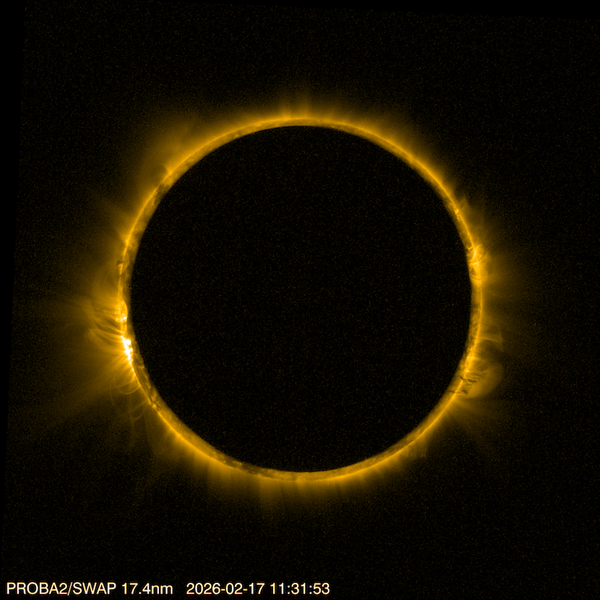
Incredible image shows what 2026’s first solar eclipse looked like from space

A satellite captured a recent “ring of fire” eclipse from a stunning new angle

The sun's ring, shown in high resolution, peeks from behind a dark circle

The "ring of fire" solar eclipse on February 17

ESA/Royal Observatory of Belgium

Join Our Community of Science Lovers!

Just days ago the moon traveled directly between Earth and the sun in what was the first solar eclipse of the year, producing a striking “ring of fire” effect in the sky. Unluckily for many sky-gazers, however, only those in Antarctica, or just off the coast of it, would have seen the full eclipse on February 17.

But now new images from the European Space Agency (ESA) reveal the solar eclipse in all its plasmatic glory thanks to ESA’s PROBA-2 satellite. PROBA-2 is a small satellite that hosts two primary instruments designed to observe the sun and other instruments to study space weather. As the craft orbited our planet, the satellite imaged the eclipse at least four times and captured a “perfect” ring of fire, according to the agency.

Also known as an annular eclipse, the ring of fire effect is created because the moon appears slightly smaller than the sun in the sky. Although the moon passes directly in between Earth and our star during this kind of eclipse, it isn’t close enough to totally block out the sun’s light, leaving a glowing halo.


On supporting science journalism

If you're enjoying this article, consider supporting our award-winning journalism by subscribing. By purchasing a subscription you are helping to ensure the future of impactful stories about the discoveries and ideas shaping our world today.
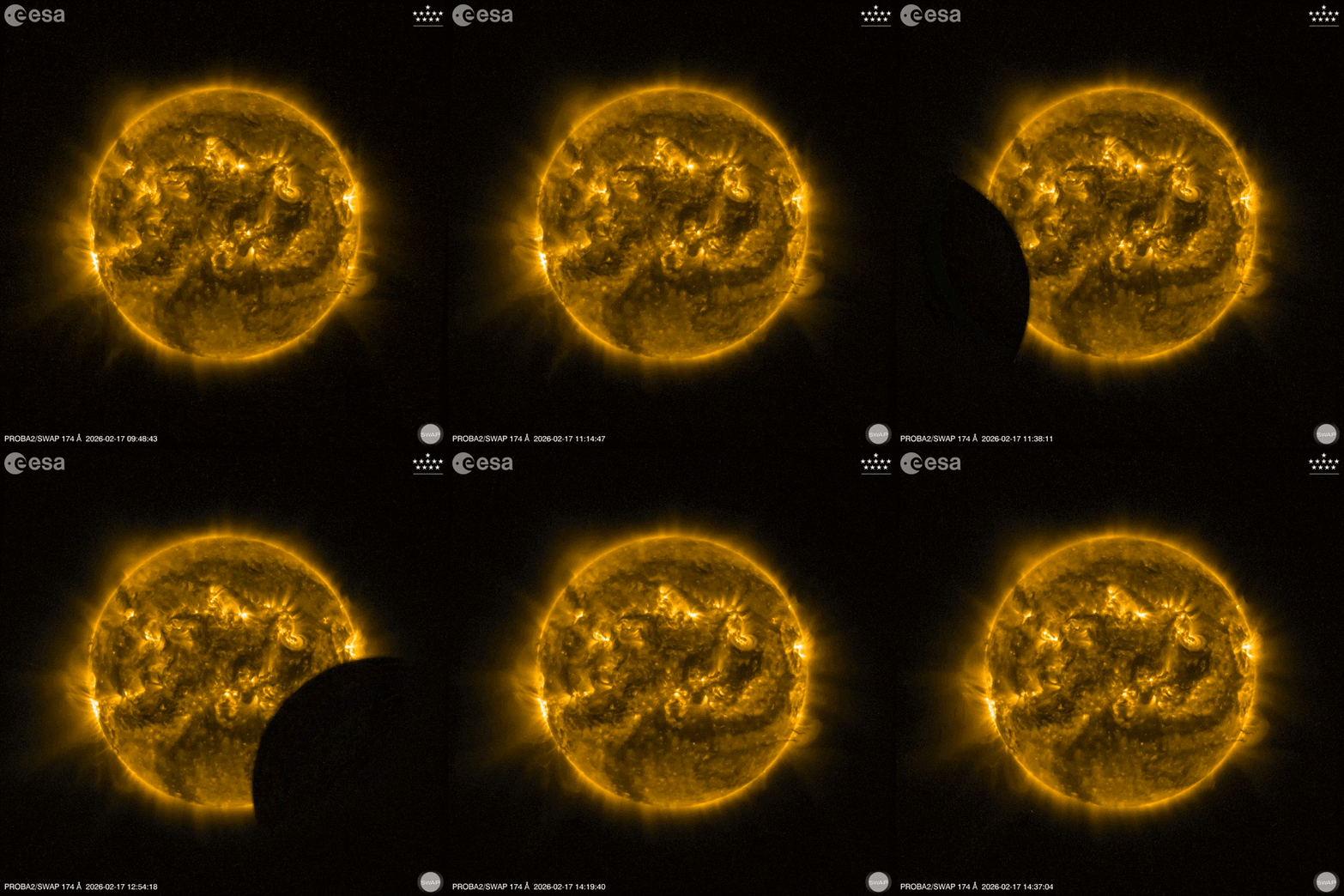

A video of the moon (a dark circle) appearing to pass over the sun four times at varying coverages

Images from four of PROBA-2's passes over the eclipse zone

ESA/Royal Observatory of Belgium

From the prime viewing spot of Concordia Station in Antarctica, the ring was reportedly visible for about two minutes.

The next eclipse of 2026 is a total lunar eclipse beginning on March 3 UTC. Then Earth will cast a shadow on the moon, imbuing it with a red hue. Known as a “blood moon,” the eclipse will be at least partially, if not totally, visible to viewers in Asia, Australia, the Pacific Islands and the Americas.

Jackie Flynn Mogensen is a breaking news reporter at Scientific American. Before joining SciAm, she was a science reporter at Mother Jones, where she received a National Academies Eric and Wendy Schmidt Award for Excellence in Science Communications in 2024. Mogensen holds a master’s degree in environmental communication and a bachelor’s degree in earth sciences from Stanford University. She is based in New York City.

More by Jackie Flynn Mogensen

Subscribe to Support Independent Journalism

Great science journalism requires human expertise, time, effort and creativity. And it costs money. That’s why I and the journalists here at Scientific American hope you’ll join our community.

When you subscribe, you are supporting staff and freelance journalists who are passionate about telling science stories that are true, important and compelling. Our editors and reporters are often experts in their fields, which means they understand the nuances of big discoveries and can untangle the breakthroughs from the hype. With a subscription, you are also supporting rigorous fact-checking to ensure the words we publish are precise and accurate. And you’re supporting original illustrations, graphics and photos that bring you closer to an advanced laboratory, an ice sheet in Antarctica or a space mission in orbit. You’re helping us craft other types of high-quality journalism as well: Our newsletters are carefully written, edited and curated by staffers you have or will come to know and love. Our Science Quickly podcast is based on original reporting, collaboration with editors and scientists and exacting production.

Subscriptions keep this engine running so we can continue to deliver thoughtful, rigorous and independent science journalism to you. In an era of viral misinformation, this work is crucial. If you value what we do, I hope you’ll consider joining us as a subscriber

Thank you,

Jeanna Bryner, Editor in Chief, Scientific American

Subscribe