
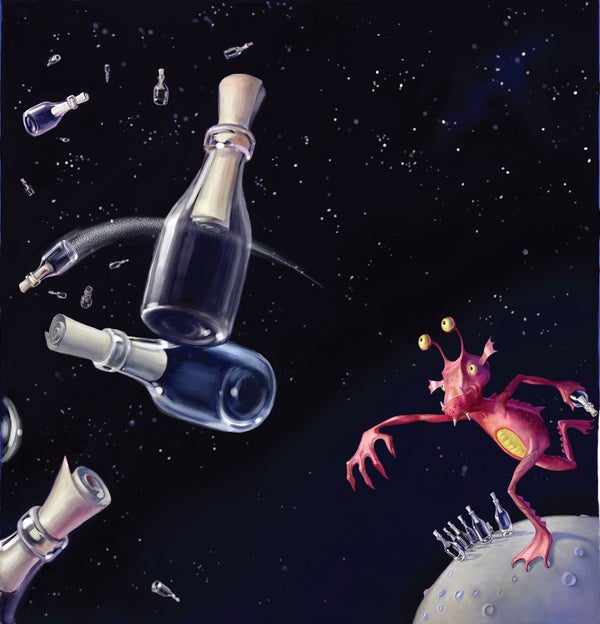
Fourteen years ago in Bremen, Germany, astronomer Seth Shostak gave a lecture that included a wager. “I bet everybody in the audience a cup of Starbucks that we would find E.T. within two dozen years,” he told a new audience in October. You don't have to be a Klaatu-level math whiz to calculate that Shostak has 10 years left before he'd have to shell out for a lot of tall drips. I'm talking about the coffee.
Shostak is senior astronomer at the Center for SETI Research based in Mountain View, Calif. SETI stands for “Search for Extraterrestrial Intelligence,” of course, as the millions who have loaned out their home computer time for the SETI@home project know. He mentioned the wager at a session on the current state of the search for any signs of alien intelligence at the World Conference of Science Journalists in the San Francisco Bay Area. The SETI conversation in question took place on the University of California, Berkeley, campus. No protesters or extraterrestrials attended. Probably.
“To have some reasonable chance of success,” Shostak said, “you'd have to look at at least a million star systems.” Which may be possible within the coffee challenge's time parameter, thanks to $100 million from Russian physicist and entrepreneur Yuri Milner in 2015 to establish what is called Breakthrough Listen—an effort to use multiple radio and optical telescopes to survey the million stars closest to us. (It recently came out that in 2015 Milner had invested in a start-up co-owned by Donald Trump's son-in-law, Jared Kushner, who is a senior White House adviser. Perhaps Milner's SETI funding represented his realization that looking for intelligent life in outer space was a better bet.)
On supporting science journalism
If you're enjoying this article, consider supporting our award-winning journalism by subscribing. By purchasing a subscription you are helping to ensure the future of impactful stories about the discoveries and ideas shaping our world today.
Shostak thinks his Bremen audience comes out ahead either way. “Because either [by 2027] a signal has been found and you have something to talk about at lunch—or you get a cup of coffee. You can't lose.”
But what about sending out messages inviting contact with intelligent aliens rather than just listening for incoming missives from faraway smarty-pants or whatever clothing may be appropriate for their anatomy? “I think the risks outweigh the benefits,” said Dan Werthimer, chief scientist at the Berkeley SETI Research Center, which oversees Breakthrough Listen. “When advanced civilizations come in contact with less advanced civilizations, it hasn't been good on Earth. So I think there's a lot of risk.”
But Shostak thinks we already might have attracted somebody's attention: “The kind of equipment that we have today is within four orders of magnitude of being able to detect radars on nearby worlds, within a few tens of light-years. Now this speed of increase in the collecting area of radio telescopes on Earth is roughly two orders of magnitude per century.... That means that any society that's at least 200 years more advanced than we are has equipment that can pick up SFO, alright? That's the local airport for those of you from out of town. So ... if you really think there's a potential of killing seven billion people because the aliens get ticked off by hearing I Love Lucy and send their interstellar battlewagons here to wipe us out..., you better turn off all the radars. Not for the weekend, not for this year, you better turn them off forever. And to me, that doesn't sound like a good idea.”
Shostak also brought up a less frightening but perhaps more existentially dreadful possibility about some future first contact: what if we finally hear from aliens broadcasting their presence as sentient beings, and the big announcement is their understanding of well-known mathematical phenomena such as the Fibonacci sequence. “That would be a real bummer, wouldn't it?” he asked. “I mean, we finally hear from E.T., and he tells us something you learned in 10th grade.”
Actually I'd be okay with it—and with them watching Lucy gobble chocolates off the conveyor belt. What I worry about is them catching the iconic Twilight Zone episode where the aliens show up with a manuscript entitled “To Serve Man,” and it ends up being a cookbook. Why give advanced carnivores any cravings?