

Imagine playing Scrabble without being able to rearrange the tiles on your rack or designing a building without sketching ideas or making models. Such a thought exercise shows the importance of environmental interaction in human thinking. But many cognitive tests meant to predict real-world achievement measure only what people can process inside their head. A new type of IQ test that lets takers “externalize” their problem-solving predicts school grades better than the original version it was based on, a recent study found.
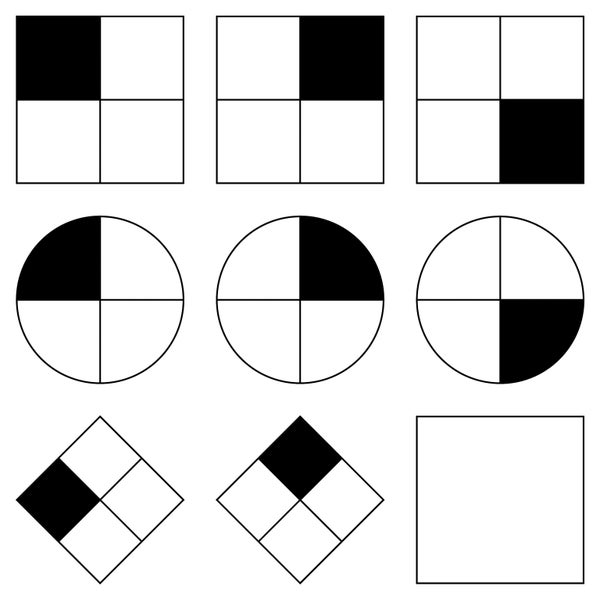
In a common IQ test called Raven’s Progressive Matrices, each question shows participants a three-by-three grid of shapes in which one is missing and asks them to select a shape that best completes the overall pattern. In the updated version, they must first arrange the eight other shapes into a coherent pattern by clicking and dragging them on a computer screen.
The new test’s creators gave 495 Dutch university students either the old or new assessment. Their scores on the original test correlated with their exam grades, but scores on the click-and-drag test predicted grades even better—by one measure more than twice as well as the original version, according to the study, which was published in the February issue of Nature Human Behaviour.
On supporting science journalism
If you're enjoying this article, consider supporting our award-winning journalism by subscribing. By purchasing a subscription you are helping to ensure the future of impactful stories about the discoveries and ideas shaping our world today.
The researchers also tracked people’s movement of shapes during the test and found that those who performed best tended to exhibit flurries of activity, with lulls in between. The study authors suspect that rather than randomly moving shapes until they fit a pattern, successful students were forming ideas, testing them and then pausing to reflect before trying a new one. “This external detour in information processing is precisely what makes it possible for people to come up with serendipitous solutions to difficult problems,” says Bruno Bocanegra, a psychologist at Erasmus University Rotterdam in the Netherlands and the paper’s lead author.
“The new test could be an asset to test problem-solving in the real world,” says Wendy Johnson, a psychologist at the University of Edinburgh, who was not involved in the research. Johnson would like to see a version of the SAT college admissions exam that also tests externalized thinking. “Overall, I think the paper is a great addition to this burgeoning field,” says Gaëlle Vallée-Tourangeau, a psychologist at Kingston University in England, who has found that interacting with the physical world helps people with creativity and statistical reasoning. “We still have a lot to learn, but it is time we move away from a dated conception of the mind as merely a computer.”