New Issue: Orbital Catastrophe Ahead? Read Now

Introducing Scientific American’s New Today in Science Newsletter

Sign up for a daily dose of discovery and awe

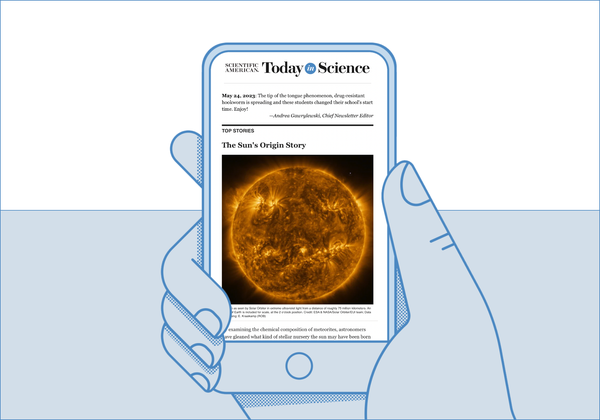
Illustration of a mobile phone displaying the Today in Science newsletter.

Scientific American

Join Our Community of Science Lovers!

We’re delighted to introduce Scientific American’s new and improved Today in Science newsletter. We hope you’ll enjoy this free daily delivery of the latest insights and discoveries from across science, health, technology, math, nature, and more. Our aim is to create a daily experience where we share what we’re learning and what we’re excited about in an informal, personal, welcoming way.

Andrea Gawrylewski will be your guide and the main author of the newsletter, which will present recommendations and highlights from across Scientific American’s editorial team. Andrea has been an editor at Scientific American for more than seven years, and she also manages our special collector’s editions, which are available on newsstands or online through an Unlimited subscription. She knows a lot of things about a lot of things, and she’s eager to share what we on staff are buzzing about.

You can sign up here for Today in Science, as well as our other newsletter offerings, including a weekly digest. Our topic-focused newsletters are hosted by specialized editors, who highlight the most fascinating stories in their areas of expertise: senior health editor Tanya Lewis writes our Health & Medicine newsletter; associate sustainability editor Andrea Thompson writes on Earth & Environment; senior space and physics editor Lee Billings writes on, you guessed it, Space & Physics; senior mind and Brain editor Gary Stix writes our Mind & Brain newsletter; and associate technology editor Sophie Bushwick hosts our Technology newsletter.


On supporting science journalism

If you're enjoying this article, consider supporting our award-winning journalism by subscribing. By purchasing a subscription you are helping to ensure the future of impactful stories about the discoveries and ideas shaping our world today.


It’s a big year for us at Scientific American. We relaunched our podcast series, called Science Quickly, which is reaching more podcast fans than ever. (I highly recommend our recent series on the biggest birds in the history of the world.) We’re updating our customer service platform to make it easier to subscribe and give gifts. Our engineering team is strengthening our infrastructure to make our website faster and improve the user experience.

We welcome your feedback on the new newsletter and everything we’re doing at Scientific American. Please feel free to contact us at editors@sciam.com or to write Andrea at newsletters@sciam.com with newsletter suggestions.

Laura Helmuth was formerly editor in chief of Scientific American. She previously worked as an editor for the Washington Post, National Geographic, Slate, Smithsonian and Science. She is a former president of the National Association of Science Writers. She is currently a member of the National Academies of Sciences, Engineering, and Medicine's standing committee on advancing science communication and an advisory board member for SciLine and The Transmitter. She has a Ph.D. in cognitive neuroscience from the University of California, Berkeley. She recently won a Friend of Darwin Award from the National Center for Science Education. Follow her on Bluesky @laurahelmuth.bsky.social

More by Laura Helmuth

Subscribe to Support Independent Journalism

Great science journalism requires human expertise, time, effort and creativity. And it costs money. That’s why I and the journalists here at Scientific American hope you’ll join our community.

When you subscribe, you are supporting staff and freelance journalists who are passionate about telling science stories that are true, important and compelling. Our editors and reporters are often experts in their fields, which means they understand the nuances of big discoveries and can untangle the breakthroughs from the hype. With a subscription, you are also supporting rigorous fact-checking to ensure the words we publish are precise and accurate. And you’re supporting original illustrations, graphics and photos that bring you closer to an advanced laboratory, an ice sheet in Antarctica or a space mission in orbit. You’re helping us craft other types of high-quality journalism as well: Our newsletters are carefully written, edited and curated by staffers you have or will come to know and love. Our Science Quickly podcast is based on original reporting, collaboration with editors and scientists and exacting production.

Subscriptions keep this engine running so we can continue to deliver thoughtful, rigorous and independent science journalism to you. In an era of viral misinformation, this work is crucial. If you value what we do, I hope you’ll consider joining us as a subscriber

Thank you,

Jeanna Bryner, Editor in Chief, Scientific American

Subscribe