
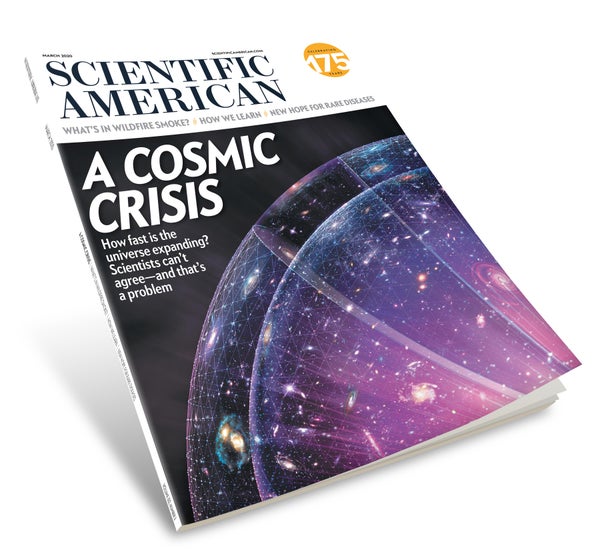
“Crisis” is a strong word. Just a few weeks before this issue went to press, the U.S. and Iran seemed to be on the brink of war. So it might seem excessive to define a situation in which there is no danger to life or limb as a crisis. But in the world of cosmology, there may be no greater predicament than two divergent measurements of how fast the universe is expanding.
Last July, when scientists gathered at the Kavli Institute for Theoretical Physics in Santa Barbara, Calif., to discuss the incongruity, “crisis” was the label they chose. Award-winning author Richard Panek explains the logic in his coverage of the expansion research: “Unlike a tension, which requires a resolution, or a problem, which requires a solution, a crisis requires a wholesale rethink. But of what?” In this case, it could be the measurement based on observations of the early universe using the cosmic microwave background, the measurement based on observations of the late universe using so-called standard candles, or the standard cosmological model itself. So, a crisis it is.
Elsewhere we turn our attention to more familiar, life-threatening examples of that classification. Journalist Kyle Dickman chronicles atmospheric chemists’ efforts to understand what dangers lurk in wildfire smoke. As a result of climate change, such blazes now happen in places they once didn’t, and they’re more intense in places where they’ve always been. Disturbingly, we still don’t know how their emissions might imperil human health, but a project called FIREX-AQ is seeking to redress that ignorance.
On supporting science journalism
If you're enjoying this article, consider supporting our award-winning journalism by subscribing. By purchasing a subscription you are helping to ensure the future of impactful stories about the discoveries and ideas shaping our world today.
Next, a pair of articles examine a form of genetic therapy that relies on antisense oligonucleotides—short strings of chemically modified DNA and RNA that incite or inhibit protein production to thwart pathology. First, journalist and Scientific American contributor Lydia Denworth and then married medical researchers Sonia Minikel Vallabh and Eric Vallabh Minikel describe applications for rare neurodegenerative diseases. Both stories are poignant—respectively, they recount the impacts of these illnesses on children and the researchers themselves (Vallabh carries a DNA mutation that puts her at grave risk for prion disease)—but also full of hope and determination in the face of adversity.
Finally, after a piece by science writer Gabriel Popkin, “What Is Killing the Monarchs?,” that lays out a new view of what is afflicting America’s most beloved butterfly, we break from crisis with rousing coverage of natural history and neuroscience.
Scientific American senior editor Kate Wong tells a tale about the discovery of what may be the oldest known example of narrative art—a 40,000-year-old cave painting of a hunt found on the island of Sulawesi in Indonesia. Following that, neuroscientist R. Douglas Fields writes the sequel to his 2008 article for this magazine about the surprising revelation that the brain’s white matter (once thought to be merely structural) plays an important part in learning. Now Fields and others have figured out exactly how glial cells alter myelin, the insulation of our neural wiring, to support the mind’s acquisition of knowledge.
In every issue, we strive for this balance between great crises in science and society and great strides in research. What the stories have in common is the power to fascinate and inspire.