
For me, there's nothing particularly special about seeing a small Cessna take to the air. But watching an Airbus A380, the world's largest commercial airliner, ascend is something altogether different. The way it lumbers into the sky just doesn't seem real. Yet mechanical and aerodynamic adaptations make flight possible for such bulky craft.
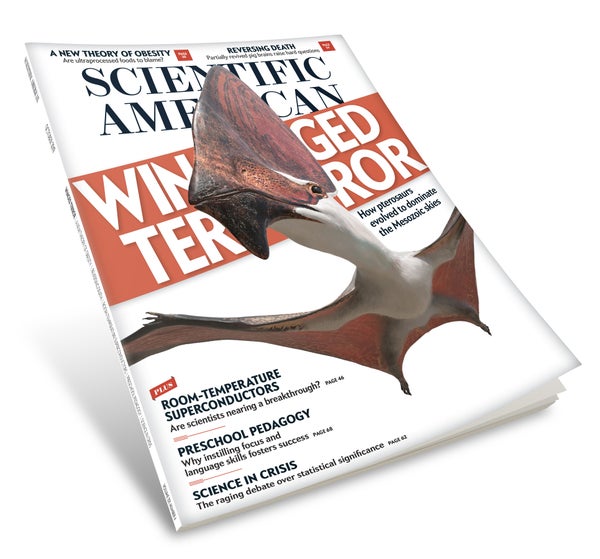
I imagine I would've had the same impression (and a dose of terror) watching a hulking pterosaur take wing, especially compared with the smaller feathered dinosaurs and birds that evolved later. Pterosaurs were the first vertebrates to fly, and while some were quite small, others were enormous. And like today's jumbo jets, an intricate set of physiological adaptations, which paleontologist Michael B. Habib details in this issue's cover story, “Monsters of the Mesozoic Skies,” allowed them to lift off. They were quadrupedal and had massive necks, for instance, much like the fearsome dragons in Game of Thrones, which inspired Habib and his colleagues when they were naming one of the pterosaur species.
Pterosaurs are now gone, as are, unfortunately, most of the 110,000 or so distinct varieties of rice that were once planted across India. Some could tolerate flood, drought, salt and pestilence; some had unique nutritional value; and some were just uniquely pleasant and used in special rituals. With the Green Revolution in the 1950s and 1960s, the government began to focus on high-yield cultivars, which can produce a lot of grain but are expensive and vulnerable to environmental assaults, and that number has dwindled to about 6,000 varieties across India today. Thankfully, as he writes in “Restoring Rice Biodiversity,” conservationist Debal Deb has made it his life's work to redress this problem.
On supporting science journalism
If you're enjoying this article, consider supporting our award-winning journalism by subscribing. By purchasing a subscription you are helping to ensure the future of impactful stories about the discoveries and ideas shaping our world today.
Whether it's rice or wheat, we should all eat more whole grains and more whole foods in general, but markets in the U.S. and elsewhere are littered with “ultraprocessed” foods, including candy bars and potato chips, as well as less obvious things like flavored yogurt and vodka. New research, which journalist Ellen Ruppel Shell describes in “Obesity on the Brain,” suggests that these unnatural concoctions disrupt gut-brain signals in a way that encourages overeating. More fruits and vegetables, preferably of heirloom varieties, please!
Elsewhere, scientists recently used a small device called a diamond anvil cell to apply about half the pressure at the center of the earth to a mix of lanthanum and hydrogen. Then they shot the mash with a laser and synthesized an entirely new material, lanthanum hydride, in hopes of finding a long-coveted room-temperature superconductor. Such a substance, which ferries a current without resistance, could accomplish technological wonders. Journalist Bob Henderson explains in “The Stuff of Dreams” how theory and computer modeling are now guiding a decades-old quest that was once based mostly on guesswork and luck.
Of course, whether it's studying ancient creatures, biodiversity or something else, all science involves a bit of conjecture and serendipity. That's part of what makes the process of research and discovery so frustrating and ever so delightful. Fortune may favor the bold, but it rewards inquisitive minds as well.