
We spend a substantial part of our days visually scanning an area for something we want—our keys or ketchup, for example. For scientists the way we do so “provides a window into how our minds sift through the information that arrives at our eyes,” says Jason Fischer, a cognitive neuroscientist at Johns Hopkins University. Past research has focused on readily apparent visual characteristics such as color, shape and size. But an object's intrinsic physical properties—things we know from experience but cannot see, such as hardness—also come into play.
“You may not be able to immediately see that a brick is heavier than a soda can and harder than a piece of cake, but you know it. And that knowledge guides how you act on a brick as compared with those other objects,” says Fischer, senior author on a new study led by graduate student Li Guo. “We asked whether that knowledge about objects' hidden physical properties is, in itself, something you can use to locate objects faster.” The study was published online in May in the Journal of Experimental Psychology: General.
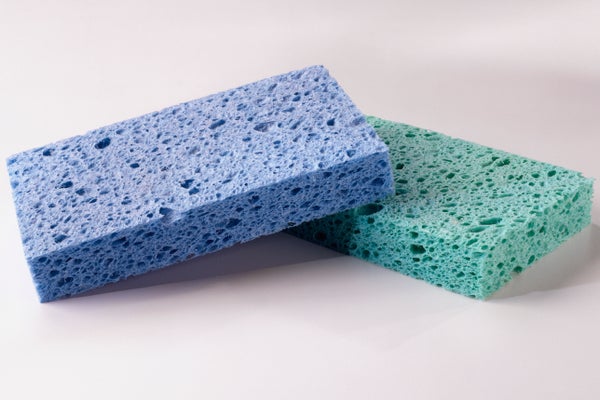
Researchers asked study participants to pick out the image of an item in a grid of other objects as quickly as possible. Each grid was controlled for the color, size and shape of the objects presented, so participants could not use easy visual cues. For example, when they were asked to find a cutting board, the grid also included softer but similarly colored items such as a croissant and a bandage and similarly shaped items, among them a sponge, pillow and paper bag.
On supporting science journalism
If you're enjoying this article, consider supporting our award-winning journalism by subscribing. By purchasing a subscription you are helping to ensure the future of impactful stories about the discoveries and ideas shaping our world today.
The researchers “found that people automatically used what they knew about an object's hardness to find it faster,” Fischer says. By tracking participants' eye movements, the team saw that people spent less time examining objects without the correct hardness. This held even when participants assessed a grid of simplistic black-and-white line drawings in which physical traits were only implied, Guo says.
“When I'm searching for an object, thinking about that object summons up a variety of useful information that my mind will leverage to find it as efficiently as possible,” Fischer explains. “It's a built-in trick that you can use without any awareness of doing so.”
Vivian C. Paulun, a vision researcher at the University of Giessen in Germany, who was not involved in the study, says it shows that a haptic (touch-based) property can influence visual attention by association. “An obvious next step would be to test whether this effect can be replicated with other mechanical, nonvisual object properties, such as fragility,” Paulun observes. “This would strengthen the evidence that physical object properties guide visual attention.”