
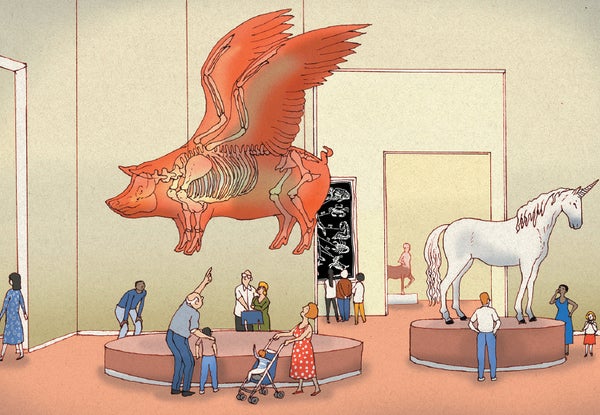
The history of science has beheld the steady replacement of the paranormal and the supernatural with the normal and the natural. Weather events once attributed to the supernatural scheming of deities are now understood to be the product of natural forces of temperature and pressure. Plagues formerly ascribed to women cavorting with the devil are currently known to be caused by bacteria and viruses. Mental illnesses previously imputed to demonic possession are today sought in genes and neurochemistry. Accidents heretofore explained by fate, karma or providence are nowadays accredited to probabilities, statistics and risk.
If we follow this trend to encompass all phenomena, what place is there for such paranormal forces as ESP or supernatural agents like God? Do we know enough to know that they cannot exist? Or is it possible there are unknown forces within our universe or intentional agents outside of it that we have yet to discover? According to California Institute of Technology physicist Sean Carroll in his intensely insightful book The Big Picture (Dutton, 2016), “All of the things you've ever seen or experienced in your life—objects, plants, animals, people—are made of a small number of particles, interacting with one another through a small number of forces.” Once you understand the fundamental laws of nature, you can scale up to planets and people and even assess the probability that God, the soul, the afterlife and ESP exist, which Carroll concludes is very low.
But isn't the history of science also strewn with the remains of failed theories such as phlogiston, miasma, spontaneous generation and the luminiferous aether? Yes, and that is how we know we are making progress. The postmodern belief that discarded ideas mean that there is no objective reality and that all theories are equal is more wrong than all the wrong theories combined. The reason has to do with the relation of the known to the unknown.
On supporting science journalism
If you're enjoying this article, consider supporting our award-winning journalism by subscribing. By purchasing a subscription you are helping to ensure the future of impactful stories about the discoveries and ideas shaping our world today.
As the sphere of the known expands into the aether of the unknown, the proportion of ignorance seems to grow—the more you know, the more you know how much you don't know. But note what happens when the radius of a sphere increases: the increase in the surface area is squared while the increase in the volume is cubed. Therefore, as the radius of the sphere of scientific knowledge doubles, the surface area of the unknown increases fourfold, but the volume of the known increases eightfold. It is at this boundary where we can stake a claim of true progress in the history of science.
Take our understanding of particles and forces, which Carroll says “seems indisputably accurate within a very wide domain of applicability,” such that “a thousand or a million years from now, whatever amazing discoveries science will have made, our descendants are not going to be saying ‘Ha-ha, those silly twenty-first-century scientists, believing in neutrons and electromagnetism.” Thus, Carroll concludes that the laws of physics “rule out the possibility of true psychic powers.” Why? Because the particles and forces of nature don't allow us to bend spoons, levitate or read minds, and “we know that there aren't new particles or forces out there yet to be discovered that would support them. Not simply because we haven't found them yet, but because we definitely would have found them if they had the right characteristics to give us the requisite powers.”
What about a supernatural God? Perhaps such an entity exists outside nature and its laws. If so, how would we detect it with our instruments? If a deity used natural forces to, say, cure someone's cancer by reprogramming the cancerous cells' DNA, that would make God nothing more than a skilled genetic engineer. If God used unknown supernatural forces, how might they interact with the known natural forces? And if such supernatural forces could somehow stir the particles in our universe, shouldn't we be able to detect them and thereby incorporate them into our theories about the natural world? Whence the supernatural?
It is at the horizon where the known meets the unknown that we are tempted to inject paranormal and supernatural forces to explain hitherto unsolved mysteries, but we must resist the temptation because such efforts can never succeed, not even in principle.