
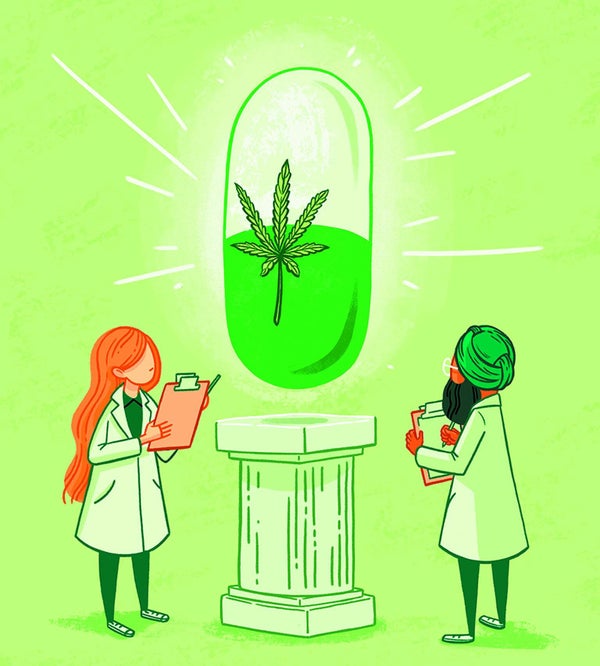
“Medical cannabis saved my life,” says Nancy Partyka, a retired college psychology instructor in Frisco, Colo. For more than 20 years Partyka battled agonizing pain stemming from a car crash that injured her cervical spine. She tried physical therapy, steroid injections, acupuncture, exercise and meditation. She endured five spinal fusion surgeries and plenty of pills. “I was taking OxyContin, taking Aleve by the handful,” she recalls, but she was spiraling downward. “The narcotics suppress your appetite. You don’t eat right, you are constipated, you feel worse. The dominos keep falling.” Ultimately Partyka says she found relief in cannabis, which is legal in Colorado. Her preferred formula, taken in an edible form, combines the plant’s two main active chemicals in a ratio of eight parts cannabidiol (CBD) to one part tetrahydrocannabinol (THC). She also uses a topical spray that is equal parts CBD and THC. “I have a life again,” says Partyka, who is back to hiking and snowshoeing. “I’m not saying I’m 100 percent pain-free. But I’m off the opioids. I almost feel normal.”
Anecdotes such as Partyka’s are not hard to find. With opioids out of favor, and medical marijuana now legal in 33 states, many people with chronic pain are looking to the nation’s budtenders for relief. Surveys suggest that pain is the single biggest reason Americans use medical marijuana, and although cannabis laws vary, all 33 states permit its use as an analgesic.
The validity of that choice got a big boost in 2017, when the National Academies of Sciences, Engineering, and Medicine released a detailed report concluding that there was “substantial evidence that cannabis is an effective treatment for chronic pain in adults.” Still, the research leaves a lot to be desired. “The data are highly conflicting,” says Sean Mackey, chief of the division of pain medicine at Stanford University Medical Center. He notes that a number of mostly small randomized clinical trials have shown “some benefit” for certain types of pain, but larger epidemiological studies are more equivocal or even negative.
On supporting science journalism
If you're enjoying this article, consider supporting our award-winning journalism by subscribing. By purchasing a subscription you are helping to ensure the future of impactful stories about the discoveries and ideas shaping our world today.
A comprehensive review of the research published last year in the journal Pain breaks this down. It found that the strongest support for cannabinoids comes from studies of pain associated with multiple sclerosis and with nerve damage. “When it comes to the most common pain problems—back and neck pain, arthritis—very few studies have been done,” says Gabrielle Campbell, a research fellow at the University of New South Wales in Australia and a co-author of the review. “For arthritis, there was only one poor-quality study.” Research quality was a problem overall, Campbell points out: just 15 studies out of 104 that were examined were highly rated for methodology, and only 21 had 100 or more participants.
Research has been inhibited by marijuana’s status as a tightly regulated Schedule I drug. Scientists must have a special license to obtain it. Another challenge is the multiple forms of cannabis: endless smokable varieties, plant extracts that can be used topically or orally, edible gummies, and so on. In addition, the products people report using are not necessarily what they think they are. CBD oil may contain more or less CBD than advertised and include unlabeled THC. A 2017 study that examined 84 cannabidiol products bought online found that 69 percent misrepresented the content.
Much of the best research on cannabis and pain involves a pharmaceutical-grade product called nabiximols (Sativex), a plant extract approved in more than 25 countries for relief of muscle spasms and related pain due to multiple sclerosis. In the U.S., however, the only approved cannabinoids are synthetic drugs for treating nausea in cancer patients and a new plant-derived drug, Epidiolex, for rare forms of epilepsy. Nothing explicitly for pain.
It would be easy to conclude, as medical experts and health columnists so often do, that patients should simply wait for better data and better products. But chronic pain is an urgent problem for millions of people, many of whom, like Partyka, are not helped by standard therapies. “When you have a patient in front of you who has tried 14 different treatments, and you have multiple randomized controlled trials showing an effect for cannabis for that condition, then I think it’s reasonable to try it if the patient is otherwise appropriate,” says Kevin Hill, director of addiction psychiatry at Beth Israel Deaconess Medical Center in Boston.
Hill agrees with European and Canadian guidelines that view cannabis as a third-tier treatment for pain. As for the holes in the data, he has an interesting suggestion: In states where cannabis is legal and taxed, why not direct some of the revenues and a portion of the booming industry profits to finding answers?