
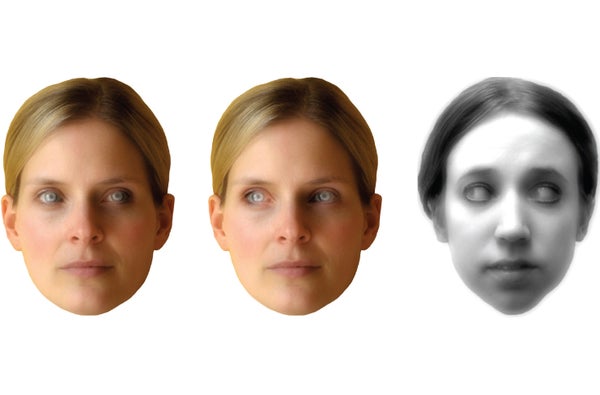
The eyes are the window to the soul. That is why we ask people to look us in the eye and tell us the truth. Or why we get worried when someone gives us the evil eye or has a wandering eye. Our language is full of expressions that refer to where people are looking—particularly if they happen to be looking in our direction.
As social primates, humans are keenly interested in determining the direction of gaze of other humans. It is important for evaluating their intentions and critical for forming bonds and negotiating relationships. Lovers stare for long stretches into each other's eyes, and infants focus intently on the eyes of their parents. Even very young babies look at simple representations of faces for longer than they look at similar cartoonish faces in which the eyes and other features have been scrambled.
In this article, we investigate a series of illusions that take advantage of the way the brain processes eyes and gaze. It turns out that it is fairly easy to trick us into thinking that someone is looking somewhere else.
On supporting science journalism
If you're enjoying this article, consider supporting our award-winning journalism by subscribing. By purchasing a subscription you are helping to ensure the future of impactful stories about the discoveries and ideas shaping our world today.
FOCUS ON THE EYES

FROM “SACCADES AND MICROSACCADES DURING VISUAL FIXATION, EXPLORATION, AND SEARCH: FOUNDATIONS FOR A COMMON SACCADIC GENERATOR,” BY JORGE OTERO-MILLAN ET AL., IN JOURNAL OF VISION, VOL. 8, NO. 14, ARTICLE 21; DECEMBER 18, 2008.
Faces, and particularly the area around the eyes, are a primary focus of our own gaze when we look at other people. The traces over the image at the left represent the eye movements produced by an experimental subject while looking at the photograph for 45 seconds.
EINSTEIN’S ALTER EGOS

COURTESY OF AUDE OLIVA M.I.T.
The ghostly gaze illusion is based on a hybrid-image technique created by Aude Oliva of the Massachusetts Institute of Technology and Philippe G. Schyns of the University of Glasgow in Scotland. In a shocking example of how perceptual interpretation of hybrid images varies with viewing distance, Albert Einstein, seen from up close, becomes Marilyn Monroe (left) or Harry Potter (right), when seen from a few meters away. For more hybrid images created by the Oliva laboratory, visit the hybrid-image gallery at http://cvcl.mit.edu/hybrid_gallery/gallery.html.
SEEING DOUBLE?

COURTESY OF FREAKINGNEWS.COM
What if you duplicate some of the features of a portrait without overlapping them completely? It is relatively easy to create images in Photoshop in which the eyes and the mouth, but no other facial features, have been doubled. The results are little short of mind-bending: as the brain struggles (and fails) to fuse the doubled-up features, the photograph appears unstable and wobbly, and observers experience something akin to double vision. The neural mechanisms for this illusion may lie within our visual system's specialized circuits for face perception. If you double up the eyes and mouth in a portrait, the neurons in the face-recognition areas of the brain may not be able to process this visual information correctly. Such failure could make the face unsteady and difficult to perceive.
HERE’S LOOKIN’ AT YOU, KID

COURTESY OF PAWAN SINHA AND TOMASO POGGIO M.I.T.
Vision researcher Pawan Sinha of the Massachusetts Institute of Technology shows us with this illusion that our brain has specialized mechanisms for determining gaze direction. In the normal photograph of Humphrey Bogart (left), the actor appears to be looking to his left, but in the photo negative (right) he appears to be looking in the opposite direction. Yet Bogart's face does not look backward; only the eyes are reversed. Why? The answer is that we have specialized modules in our brain that determine gaze direction by comparing the dark parts of the eyes (the irises and pupils) with the whites. When the face is negative, the whites and irises appear to swap position. Our knowledge that irises are light rather than dark in a negative does not change our perception of this illusion.
FOLLOW MY FINGER

COURTESY OF LIBRARY OF CONGRESS, PRINTS & PHOTOGRAPHS DIVISION
The artists who drew these World War I recruiting posters knew something about eye tracking. No matter how you look at Uncle Sam (right) or British Field Marshal Lord Kitchener (left), the eyes and finger seem to be pointed directly at you. Today you can experience the same phenomenon in an art museum, where the painted eyes in portraits sometimes seem to follow you around the room.
Such eye tracking is not only a B-movie horror flick cliché but also a powerful illusion that continues to inspire visual science studies. In 2004 vision psychologists Jan Koenderink, Andrea van Doorn and Astrid Kappers, all then at Utrecht University in the Netherlands, along with James Todd of Ohio State University, concluded that, contrary to popular belief, this compelling illusion does not require special artistic abilities on the part of the painter. Surprisingly, all that is required is that the person portrayed looks straight ahead, and the observer's visual system takes care of the rest.
The deceptively simple explanation is that when we look at a real human face or anything else in our three-dimensional physical world, the visual information that specifies near and far points changes with our viewing angle. But when we observe a two-dimensional painting or photograph hanging on the wall or a poster such as the ones above, the visual information that defines near and far points remains unaltered by our viewing angle. The brain interprets this information as if it pertained to a 3-D object, however. That interpretation is what creates the eerie sensation that a portrait's eyes are following you.
CONTEXTUAL CUES

COURTESY OF AKIYOSHI KITAOKA Ritsumeikan University
Contextual cues, such as the position of the face and the head, also influence the perceived direction of gaze. In this illusion created by Akiyoshi Kitaoka, a professor of psychology at Ritsumeikan University in Japan, the girl on the left appears to gaze directly at you, whereas the girl on the right appears to be looking to her left. In reality, the eyes of both girls are identical. This illusion was first described in 1824 by British chemist and natural philosopher William Hyde Wollaston, who also discovered the elements palladium and rhodium.
ANIMAL “EYES”

ANDREW DARRINGTON Alamy (top left); DARLYNE A. MURAWSKI Getty Images (bottom left); SHAUN CUNNINGHAM Alamy (top center); DAVID FLEETHAM Getty Images (top right); PAUL E. TESSIER Getty Images (bottom right)
A fascination with eyes is not solely a human trait. Many species of fish, insects and even birds sport false (one could say illusory) eyes on their wings, stalks or even the back of their head. These eye-catching patterns serve to dissuade, confuse or startle potential predators. Get an eyeful of these animals that sport eyespots (clockwise from upper left): an emperor moth with four false eyes, a northern pygmy owl with “eyes” in the back of its head, a butterfly fish with a fake eye that draws attention away from its head, an insect named the eyed click beetle, and a spicebush swallowtail caterpillar.