
Blueberries are nutritious, delicious and—if unwashed—probably coated in a film of pesticide residue.
The squidgy berries were highlighted by the Environmental Working Group (EWG) in this year’s “Dirty Dozen” analysis, an annual look at which fruits and vegetables have the highest amounts of pesticide residue, based on data from the U.S. Department of Agriculture. Alongside the blueberries were spinach, kale, strawberries, grapes, nectarines, peaches, cherries, apples, blackberries, pears and potatoes.
A quick dip under a faucet helps to clean these residues off. But for extra pesticide-busting effects, some food scientists recommend adding common kitchen ingredients to a produce wash. (Don’t use soap or detergents—those products aren’t food safe and can be absorbed by fruits and vegetables.)
On supporting science journalism
If you're enjoying this article, consider supporting our award-winning journalism by subscribing. By purchasing a subscription you are helping to ensure the future of impactful stories about the discoveries and ideas shaping our world today.
The produce items highlighted in the report are already safe according to federal guidelines: each is under the legal limits on pesticide exposure set by the U.S. Environmental Protection Agency. But scientists haven’t fully evaluated the long-term effects of consuming many pesticides used on produce.
“The benefits of eating fruits and vegetables definitely outweigh the risk of pesticide exposure,” says Dayna de Montagnac, an associate scientist at EWG. “But we should be able to enjoy the benefits of having nutritious fruits and vegetables that are free of pesticide residues.”
More than 30 percent of the fruit and vegetables sampled, the report found, contained PFAS, or perfluoroalkyl and polyfluoroalkyl substances. These “forever chemicals” break down very slowly over time, hence the nickname. They have been linked to a variety of negative health effects, such as a decreased immune response, altered metabolic signaling, and even an increased risk of certain types of cancer.
“Whether your fruits and vegetables are organic or not..., always take the time to wash your fruits and vegetables before eating them.” —Dayna de Montagnac Environmental Working Group
Some people may be more at risk from PFAS than others, says Sarah Evans, an associate professor of environmental health at the Icahn School of Medicine at Mount Sinai. “We do have concerns, particularly about children and also pregnant people, because exposures to PFAS and pesticide chemicals we know can be more harmful to the developing brain and reproductive system in particular,” she explains. Regardless of who you are, reducing your exposure “may have beneficial health outcomes in the long run,” Evans says.
One simple way to lower risk is to wash your produce. “The general rule is, no matter what, whether your fruits and vegetables are organic or not, on the Dirty Dozen list or not, to always take the time to wash your fruits and vegetables before eating them,” de Montagnac says.
To do a basic wash, put produce under running water for 20 seconds or soak it in water for 15 to 20 minutes. For firmer items, such as cucumbers and melons, the U.S. Food and Drug Administration recommends scrubbing their surfaces with a clean produce brush. But this kind of washing cannot guarantee produce will be completely rid of pesticide residue. Indeed, the Dirty Dozen list is based on measurements taken after the fruits and vegetables are washed.
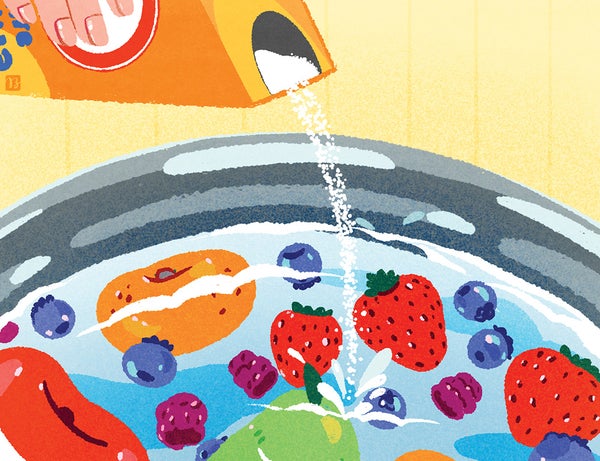
So what to do? According to EWG’s guide to washing produce, adding a little baking soda or vinegar to water and soaking produce for five to 10 minutes can help break down certain pesticides and may be more effective than water alone.
Different pesticides will wash away more thoroughly with different additives to water, says Lili He, head of the food science department at the University of Massachusetts Amherst. Baking soda, for instance, makes water more alkaline, and some surface pesticides aren’t stable in alkaline conditions. The fungicide thiabendazole is one of them, and in a 2025 study, He found that baking soda appears to work particularly well at removing it.
He advises immersing unwashed produce in a bowl of water in the sink and adding about one teaspoon of baking soda per cup of water. Wait 10 minutes, then remove the produce from the bowl and rinse it off with clean water. “That’s a simple process you can do to reduce the risk,” she says.
Other researchers have evaluated how pesticides fare against acidic household substances such as rice vinegar. The scientists left pesticide-treated lettuce in containers of water and a little vinegar for 10 minutes, then rinsed them in salad spinners and let them dry. Rice vinegar washed off an average of 76.3 percent of seven different pesticides, a greater amount than observed with other vinegar types. It’s not complete elimination, but it goes a long way toward it.