
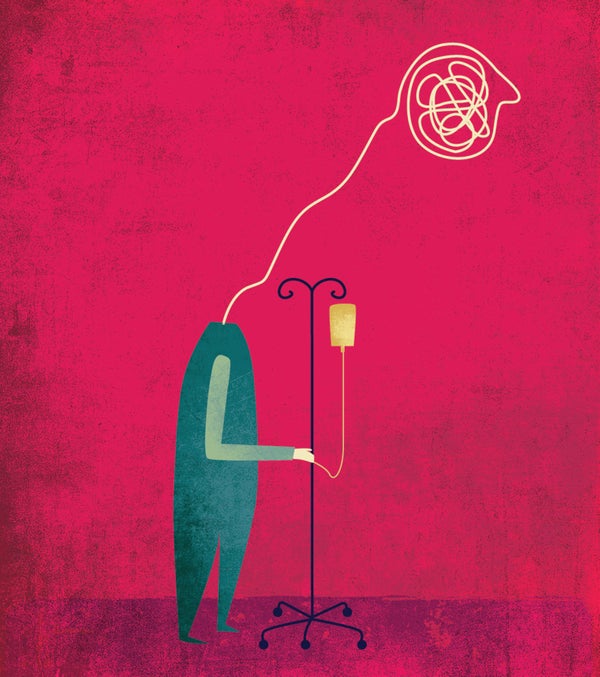
As a young attending physician at a Connecticut medical center 35 years ago, Sharon Inouye was shocked by the disturbing changes she saw in many older patients. They would arrive at the hospital clear-headed and focused but soon became confused and disoriented—for no obvious or consistent reason. Some developed delusions and thrashing agitation; others seemed sedated and out of it. “I asked other physicians about it, and they were dismissive,” she recalls. This muddled state known as delirium “was taken as an expected thing” for older patients, but Inouye found it to be both unacceptable and deeply interesting. Now a geriatrician and professor at Harvard Medical School, she is one of the world’s leading investigators of delirium, the toll it can take and how to prevent it.
Delirium is astonishingly common. It affects between 10 and 50 percent of hospitalized patients aged 65 and older, whether they have had surgery or not, and up to 85 percent of those in intensive care units. It is the number-one complication of surgery in this demographic. And yet until recently, delirium was rarely mentioned to patients or their families. One reason that is changing is the dramatic rise in elderly surgical patients. “It’s only in recent years that we started to see a large number of patients in their 80s and 90s coming to surgery,” says Frederick Sieber, chair of the department of anesthesiology and critical care medicine at Johns Hopkins University School of Medicine.
Another reason delirium is finally getting attention is that research by Inouye and others has shown that for many patients the condition is associated with longer-term risks, including loss of mental acuity. This is the phenomenon, sadly familiar to many families, of Grandpa never being quite the same after an operation. Whether delirium causes enduring harm to the brain or merely exposes and perhaps accelerates preexisting cognitive issues is not clear. Nor is it clear how anesthesia or surgery might trigger the condition. Sieber, for example, has extensively studied whether using local rather than general anesthesia and using mild versus heavy sedation make a difference. They do not. What seems to be driving the risk, he says, are underlying vulnerabilities that include chronic diseases and incipient dementia.
On supporting science journalism
If you're enjoying this article, consider supporting our award-winning journalism by subscribing. By purchasing a subscription you are helping to ensure the future of impactful stories about the discoveries and ideas shaping our world today.
The consequences of delirium, if it lasts more than a few days and especially if it is followed by cognitive decline, are enormous. “It’s a house of cards,” Inouye says. “Patients start getting treated with medications for agitation or disruptive behavior, and those medications lead to complications. Or they are very sedated, and that leads to complications.” Delirious patients may choke on their food or pills and die of aspiration pneumonia. They may wind up in bed for long periods and suffer fatal blood clots. Once up, they are prone to falling. It’s a downward spiral and a costly one. Delirium adds more than $183 billion a year to U.S. health care costs, outstripping congestive heart failure.
Fortunately, basic steps can be taken to prevent delirium or shorten its course, such as making sure the patient is well hydrated, has access to eyeglasses and hearing aids if he or she uses them, gets out of bed and walks as soon as possible, has adequate sleep, and is socially engaged by hospital staff and loved ones. These are some of the measures included in the Hospital Elder Life Program (HELP), first developed by Inouye and her colleagues in 1993 and now in use in hundreds of hospitals around the world. Studies show it reduces the risk of delirium by 30 to 50 percent, shortens its course when it does occur and cuts the rate of falls by 42 percent. Notably it saves between $1,600 and $3,800 per patient in hospital costs and more than $16,000 in long-term care costs in the year following delirium.
This month AARP, via its affiliated Global Council on Brain Health, is releasing a report on delirium aimed at helping people reduce their risk and improve their outcome, particularly the 50 percent or so who will face surgery at some point after age 65, says Sarah Lenz Lock, senior vice president of policy and brain health at AARP. She wishes she had known more about it when her own mother “wigged out” after an aortic repair. Lock says she would have set up bedside shifts with family so that her mom was never alone: “I would have made sure she went in hydrated and been prepared that recovery might take a little longer.”