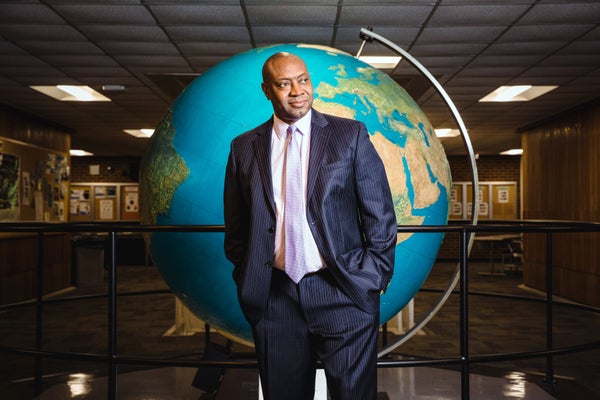
J. Marshall Shepherd is the Georgia Athletic Association Distinguished Professor and Regents’ Professor at the University of Georgia and director of the atmospheric sciences program at the University of Georgia. And he was the 2013 president of the American Meteorological Society.
[This interview was edited for length and clarity.]
How would you describe the current state of American science?
On supporting science journalism
If you're enjoying this article, consider supporting our award-winning journalism by subscribing. By purchasing a subscription you are helping to ensure the future of impactful stories about the discoveries and ideas shaping our world today.
You know, we still have some of the best scientists and innovation and technology and resources in the world. When I think about my own field, which encompasses meteorology and climate science, and I look at where we are, we have made tremendous advances in weather forecasting technology and accuracy. When I look at things like dual‑polarimetric Doppler radar and advanced weather satellites and a new generation of artificial-intelligence‑based forecast models, which can nail tornadoes, now, two hours in advance or tell us, seven days, out exactly where a hurricane is going to make landfall—just from the lens of my own discipline, I believe that we are in a very exciting time for innovation, science and technology. There are certainly headwinds in that space, but we still have some of the brightest minds and best resources and best systems in the world.
What needs to change in American science?
I believe we need to produce what I call end‑to‑end science, from a training standpoint. When we train the next generation of scholars, scientists, technologists, engineers, mathematicians, and so forth, we do a really good job training them to write dissertations and master’s theses and present at scientific conferences. We don’t do a great job of producing what I call end‑to‑end scientists—scientists that can communicate with the media, testify before policymakers and think about the translational aspects of what they're doing more than just the theoretical lab, ivory‑tower framing of that work.
What gives you optimism right now?
What gives me optimism is: we are facing some daunting challenges—everything from ... COVID to climate change—but in all of those cases, they aren’t necessarily wicked problems. We have solutions. We have the know‑how. In the case of COVID, the science, technology and medical community rapidly developed vaccines that could counter the impacts of such viruses.
In the case of weather forecasting, we have not seen, essentially, a wind‑shear‑related aviation accident in many years. That used to happen all of the time 40, 50 years ago. In the case of Hurricane Melissa in 2025, we knew many, many days in advance that Jamaica was going to face a catastrophic hurricane and were able to get prepared. So we have the technology to face some of the daunting challenges of our time. Even things like climate change—while dire and certainly the crisis of a generation—we know what needs to be done, both on the mitigation front—reduction of carbon emissions—and also the adaptation front. We have the technology, we have the engineering to transition to renewable fuels, to develop infrastructure resiliency through new, innovative technology. We’re not sitting around at the mercy of the challenges. We have the scientific and technical know‑how. We just need the will and the funding.
What’s your best advice for an early‑career scientist?
My best advice for an early‑career scientist is to become an end‑to‑end scientist. Develop the skill sets that we traditionally expect—publishing rigorous research [and] replication of that research and presenting it in scholarly ways—but also develop skill sets in writing, persuasive writing, speaking, oratorical skills, the ability to talk to the media.
If my colleagues in the ivory tower are hesitant to tweet or engage on social media, when, in fact, most people now receive their scientific information from social media or the Internet, we, as scholars, have to be in those spaces, too. If we’re not, people with misinformation, disinformation or lack of expertise will fill those voids.
How has your field changed in the past few years?
The emergence of artificial intelligence. Back in 2025 some of the best hurricane forecast models were AI‑based models. We can’t fear them. There are opportunities for really improving our weather and diagnostic forecasting capacity. Yes, there are challenges with data centers, water and energy use, but I’m confident we can figure that out technologically.
Beyond that, advanced radar, satellite capabilities, phased‑array weather radars—these will be game changers. But one of the biggest changes I’ve seen is the incorporation of social and behavioral sciences. A forecast can be technically perfect, but if people don’t receive, understand or interpret it properly, it fails.