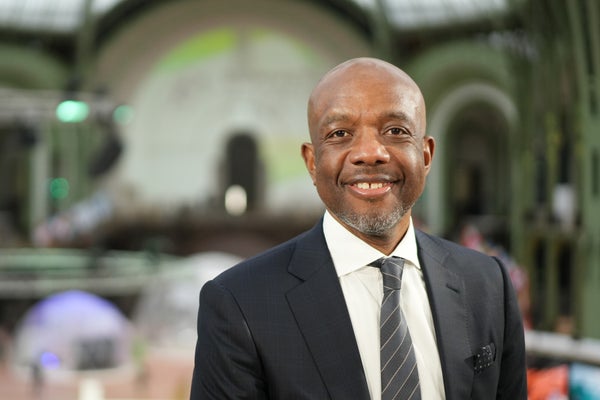
James Manyika is a technology executive and researcher focused on the intersection of technology, economics and society. He serves as senior vice president for research, labs, technology and society at Google and Alphabet.
[This interview was edited for length and clarity.]
How would you describe the current state of American science?
On supporting science journalism
If you're enjoying this article, consider supporting our award-winning journalism by subscribing. By purchasing a subscription you are helping to ensure the future of impactful stories about the discoveries and ideas shaping our world today.
This is a tremendously exciting moment for those of us working at the intersection of artificial intelligence and science. The feeling is not unlike how people working in generative AI felt in early 2022, with so much happening at an unprecedented speed and scale across the life sciences, physical sciences—even the formal sciences.
Scientists are able to condense hundreds of years of research into months or even days, and that progress is happening across domains—life sciences, physical sciences, and even mathematics and computer science. A lot of that research is turning into reality through applications ranging from health care and weather forecasting to food security.
What needs to change in American science?
The traditional research relationships between academia, industry and governments need to be rethought and reset. At present, training AI models is both data- and compute-intensive, requiring resources that most academic and national labs do not currently possess. While research progress on lighter-weight models continues, a key avenue for progress remains deep collaboration and partnership between frontier AI labs and academic scientists.
What gives you optimism right now?
We’re making progress across domains—neuroscience, materials science, physics, mathematics, atmospheric and physical science—and even bidirectional progress in areas such as quantum AI. And that progress can improve people’s lives at scale. One of my favorite examples is the progress we’re making in weather and forecasting. It starts with a tricky research question: How do you build hydrology models to predict riverine floods? We were able to use AI-based technologies to improve global-scale forecasting and extend the reliability—now Google’s Flood Hub covers over two billion people in more than 150 countries.
The other thing that makes me optimistic is the way AI is democratizing science. While I imagine almost every reader of Scientific American knows about my colleagues Demis Hassabis and John Jumper’s work on protein prediction with AlphaFold, the less told story is around the freely available AlphaFold Protein Database, which has been used by more than three million researchers across more than 190 countries. And we’re seeing encouraging progress on a number of other open-access research tools and resources in areas such as genomics, connectomics and geospatial insights.
What’s your best advice for an early-career scientist?
Some of the most exciting early-career scientists I know have ignored the dichotomies between theoretical, computational and experimental science to think and work across disciplines. Regardless of their areas of study, I think having a sophisticated understanding of state-of-the-art AI capabilities will serve any scientist well and increase their ability to effectively evaluate outputs. Fundamentally, as agentic tools become increasingly capable, one of the most effective skills will be a scientist’s ability to frame questions and design lines of inquiry.
How has your field changed in the past few years?
One of the most profound changes is how AI is shifting research from answering one question at a time to answering many—from predicting one protein to predicting all of them.