New Issue: Orbital Catastrophe Ahead? Read Now

James Webb Space Telescope Launch Delayed to Christmas Eve—or Later

A communications glitch between the observatory and its launch vehicle forced the delay, NASA officials say

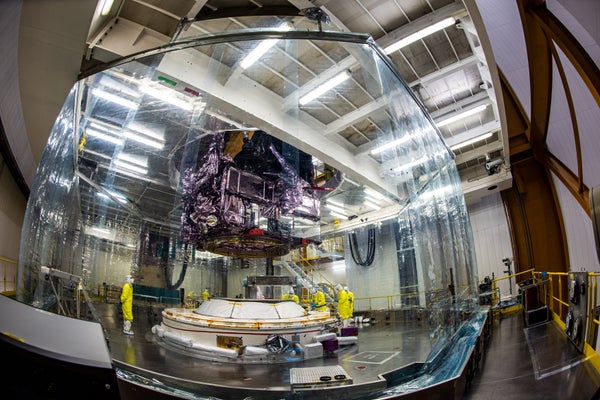
Technicians work on a telescope on the Ariane 5 rocket.

Technicians work to secure the James Webb Space Telescope atop the Ariane 5 rocket that will launch it to space from Europe’s spaceport in Kourou, French Guiana.

Join Our Community of Science Lovers!

The launch of NASA’s James Webb Space Telescope has been delayed yet again.

NASA’s long-awaited space observatory is now scheduled to lift off from French Guiana no earlier than Dec. 24, two days later than previously planned. 

“The James Webb Space Telescope team is working a communication issue between the observatory and the launch vehicle system,” NASA officials said in a statement on Tuesday (Dec. 14). “This will delay the launch date to no earlier than Friday, Dec. 24. We will provide more information about the new launch date no later than Friday, Dec. 17.”


On supporting science journalism

If you're enjoying this article, consider supporting our award-winning journalism by subscribing. By purchasing a subscription you are helping to ensure the future of impactful stories about the discoveries and ideas shaping our world today.


The James Webb Space Telescope will ride to space on an Ariane 5 rocket provided by the European launch company Arianespace. 

Engineers at the Guiana Space Center in Kourou, French Guiana, just stacked the new space telescope on top of its Ariane 5 rocket on Saturday (Dec. 11).

Today’s delay is only the latest in a series of ongoing delays that have plagued the Webb telescope, which was originally scheduled to launch in 2007. The most recent delay was announced just three weeks ago, when NASA reported a problem with a clamp on the launch vehicle adapter. 

Copyright 2021 Space.com, a Future company. All rights reserved. This material may not be published, broadcast, rewritten or redistributed.

Subscribe to Support Independent Journalism

Great science journalism requires human expertise, time, effort and creativity. And it costs money. That’s why I and the journalists here at Scientific American hope you’ll join our community.

When you subscribe, you are supporting staff and freelance journalists who are passionate about telling science stories that are true, important and compelling. Our editors and reporters are often experts in their fields, which means they understand the nuances of big discoveries and can untangle the breakthroughs from the hype. With a subscription, you are also supporting rigorous fact-checking to ensure the words we publish are precise and accurate. And you’re supporting original illustrations, graphics and photos that bring you closer to an advanced laboratory, an ice sheet in Antarctica or a space mission in orbit. You’re helping us craft other types of high-quality journalism as well: Our newsletters are carefully written, edited and curated by staffers you have or will come to know and love. Our Science Quickly podcast is based on original reporting, collaboration with editors and scientists and exacting production.

Subscriptions keep this engine running so we can continue to deliver thoughtful, rigorous and independent science journalism to you. In an era of viral misinformation, this work is crucial. If you value what we do, I hope you’ll consider joining us as a subscriber

Thank you,

Jeanna Bryner, Editor in Chief, Scientific American

Subscribe