New Issue: Orbital Catastrophe Ahead? Read Now

Jane Goodall, Trailblazing Primatologist and Chimpanzee Conservationist, Has Died

The anthropologist was famous for her pioneering research with chimpanzees and her influence on conservation

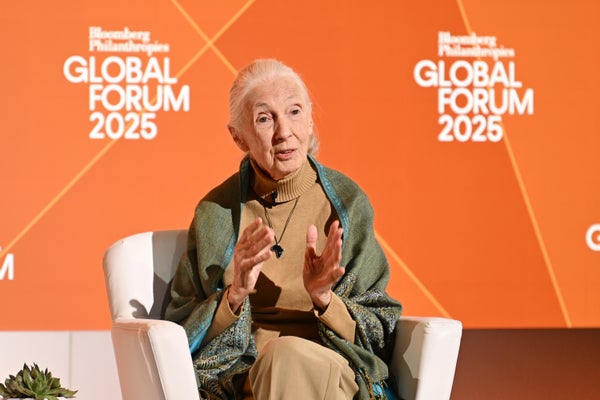
A photo of Jane Goodall speaking

Jane Goodall speaks onstage at the Bloomberg Philanthropies Global Forum 2025 at the Plaza Hotel on September 24, 2025, in New York City.

Bryan Bedder/Bloomberg Philanthropies/Getty Images

Join Our Community of Science Lovers!

Iconic primatologist and conservation scientist Jane Goodall has died at the age of 91 from natural causes, according to a statement from the Jane Goodall Institute, which she founded in 1977.

Goodall was best known for her pioneering studies of chimpanzees in the wild. She visited Tanzania for the first time in 1960, when she was 26, and began observing chimpanzees at what was then called Gombe Stream Game Reserve. Unlike more traditional scientific observations, Goodall named the chimpanzees she watched, rather than referring to them by numbers, and she brought a keen eye and emotional connection to her view of their behaviors. (She also regularly went barefoot, according to the institute she founded.)

READ MORE: Jane Goodall on Traveling the World and Speaking Up for Animals


On supporting science journalism

If you're enjoying this article, consider supporting our award-winning journalism by subscribing. By purchasing a subscription you are helping to ensure the future of impactful stories about the discoveries and ideas shaping our world today.


Early in her work in Gombe, Goodall observed a chimpanzee she called David Greybeard at work foraging for termites using bits of plant matter. She documented tool use among chimps in an era when scientists believed that only humans had such capacity. Although Goodall said she had expected the chimpanzees she studied to be highly intelligent, the animals were scientific mysteries at the time.

As her research became more prominent, she became an iconic scientist—and an inspiration for women in science—and then an outspoken advocate of conservation.

Scientific American spoke with Goodall in 2010 to mark her 50th anniversary with chimpanzees and asked her what she considered her most significant contributions.

“Breaking down this perceived sharp line between us and other creatures,” Goodall said. “I think chimpanzees have helped people understand that we are part of and not separated from the animal kingdom, and that has opened the way to having respect for the other amazing beings with whom we share the planet.”

Meghan Bartels is a science journalist based in New York City. She was previously a senior reporter at Scientific American. Before that she spent more than four years as a writer and editor at Space.com, as well as nearly a year as a science reporter at Newsweek, where she focused on space and Earth science. Her writing has also appeared in Audubon, Nautilus, Astronomy and Smithsonian, among other publications. She attended Georgetown University and earned a master’s degree in journalism at New York University’s Science, Health and Environmental Reporting Program.

More by Meghan Bartels

Subscribe to Support Independent Journalism

Great science journalism requires human expertise, time, effort and creativity. And it costs money. That’s why I and the journalists here at Scientific American hope you’ll join our community.

When you subscribe, you are supporting staff and freelance journalists who are passionate about telling science stories that are true, important and compelling. Our editors and reporters are often experts in their fields, which means they understand the nuances of big discoveries and can untangle the breakthroughs from the hype. With a subscription, you are also supporting rigorous fact-checking to ensure the words we publish are precise and accurate. And you’re supporting original illustrations, graphics and photos that bring you closer to an advanced laboratory, an ice sheet in Antarctica or a space mission in orbit. You’re helping us craft other types of high-quality journalism as well: Our newsletters are carefully written, edited and curated by staffers you have or will come to know and love. Our Science Quickly podcast is based on original reporting, collaboration with editors and scientists and exacting production.

Subscriptions keep this engine running so we can continue to deliver thoughtful, rigorous and independent science journalism to you. In an era of viral misinformation, this work is crucial. If you value what we do, I hope you’ll consider joining us as a subscriber

Thank you,

Jeanna Bryner, Editor in Chief, Scientific American

Subscribe