
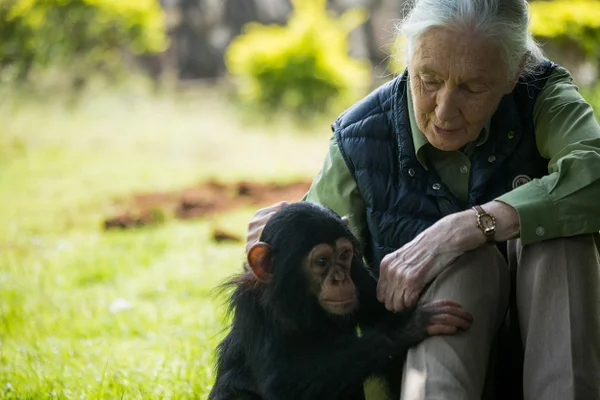
Jane Goodall, a British primatologist known for her work with chimpanzees, died on Wednesday 1 October, aged 91. She was in California on a speaking tour and died of natural causes, according to the Jane Goodall Institute.
Goodall is best known for her work with chimpanzees in Gombe National Park in Tanzania. She was the first to discover that chimpanzees made and used tools. She went on to become an advocate for conservation, human rights and animal welfare, including stopping the use of animals in medical research. She established the Jane Goodall Institute, a non-profit wildlife and conservation organization in Washington DC, in 1977.
Here are the ways in which Goodall’s legacy will endure.
On supporting science journalism
If you're enjoying this article, consider supporting our award-winning journalism by subscribing. By purchasing a subscription you are helping to ensure the future of impactful stories about the discoveries and ideas shaping our world today.
Humanizing primates
While studying for her PhD at the University of Cambridge, UK, in the early 1960s, Goodall broke with the scientific convention of using numbers to identify animals, assigning them names instead. She named a male chimp with silver facial hair David Greybeard. This change upset senior scientists at the time, but it is now common practice to use animal names.
“It was criticized as unscientific,” says Mireya Mayor, an anthropologist and primatologist at Florida International University in Miami, “but she proved that science could extend its boundaries without losing rigour.”
Goodall was among the first to show that animals had emotions, empathy and culture, traits that had been reserved for humans, Mayor says. Her research changed how animal studies were conducted, she adds.
Her discoveries in Gombe National Park “redefined humanity”, says Nick Boyle, executive director of Taronga Zoo in Sydney, Australia. Goodall challenged the idea that chimpanzees were herbivores, and showed that they ate meat, hunted and engaged in warfare, he adds. In 1973, Goodall observed a social divide between two chimpanzee communities that led to a four-year conflict and the deaths of all of the male apes in one of the communities.
Inspiring women scientists
Beyond primatology, Goodall’s legacy is the generations of women she inspired to follow in her footsteps into fieldwork, says Mayor. In 1961, Goodall was one of the few students accepted into a PhD at Cambridge without an undergraduate degree. She completed her PhD in 1965.
“She showed that a young woman with no formal scientific training could rewrite science and the understanding of animals on such a fundamental level,” adds Mayor.
Alison Behie, an anthropologist at the Australian National University, was one of the women Goodall inspired. After attending a talk by Goodall, Behie says she switched her undergraduate major from microbiology to anthropology and started taking primatology and conservation courses. “It was just a happy coincidence, but she came to speak at the exact time that I was not quite sure what sort of science I wanted to do,” she says.
In 2017, Behie introduced eight of her female students to Goodall during her visit to Australia. “It was a full circle for me to be able to show my own students what had inspired me to go down this path.”
Communicating science
The secret to Goodall’s impact and popularity is that she made her research relatable, says Behie. Goodall connected the science to things that people worry and care about, such as the relationship between a mother and child, and showed how similar chimpanzees are to people. She made them care about places and animals that were far away, adds Mayor.
She was a talented storyteller, which helped her to connect with the public and engage them on important issues, says Euan Ritchie, a conservation scientist at Deakin University in Melbourne, Australia. She showed it is possible for researchers to be advocates and science communicators and be taken seriously, he says.
Long-time collaborator Thomas Gillespie, a disease ecologist at Emory University in Atlanta, Georgia, says that Goodall was an introvert, so her success and ability to connect with the public required a lot of discipline.
She always made time for young people, says Boyle. “She was a messenger of hope” and she saw that young people were so crucial in that, he adds. Her youth programme, Roots and Shoots, established in 1991, was a way to educate young people and involve them in conservation efforts. “That was her baby,” says Maria Sykes, chief executive of the Jane Goodall Institute Australia.
But there were sides to Goodall that the public was unlikely to see, says Mayor. “What most people don't know,” Mayor says, is that “Jane was incredibly fun and flirtatious, even at 90”.
This article is reproduced with permission and was first published on October 2, 2025.