
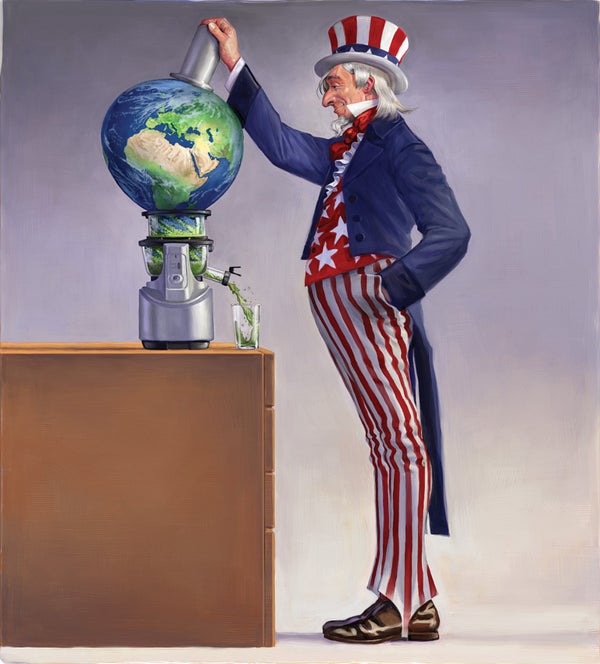
Perhaps the only funny item in Jared Diamond’s new book Upheaval: Turning Points for Nations in Crisis is an anecdote about what was known as the Winter War. When the Soviet Union invaded Finland in late 1939, the Finns resisted against the much larger Soviet forces until the two countries compromised on an uneasy peace.
Various countries sent equipment to help Finland defend itself. One such gift was World War I artillery from Italy. “Each artillery piece requires not only a gunner … but also someone called a spotter stationed some distance in front of the gun, in order to spot where the shell lands and thereby to correct the range setting for the next shot,” Diamond explains. Of course, these large guns have hefty recoils—and they were not designed well for absorbing that jolt. So the Finns wound up using two spotters: the usual one in front to see where the shell landed, “plus another spotter behind the gun to see where the gun landed!”
Other than that story, the book ranges from unemotionally informational to somewhat grim—but necessarily so. Diamond—a professor of geography at the University of California, Los Angeles, National Medal of Science honoree, recipient of a MacArthur “genius grant” and winner of the Pulitzer Prize for nonfiction—focuses on seven countries he knows well, including us, aka the U.S., as the convenient abbreviation would have it.
On supporting science journalism
If you're enjoying this article, consider supporting our award-winning journalism by subscribing. By purchasing a subscription you are helping to ensure the future of impactful stories about the discoveries and ideas shaping our world today.
We and the world are facing big problems, and Diamond points out that we’re never going to solve those problems without acknowledging their existence. In fact, he sets up his arguments by examining how individuals in personal crises do or do not deal with those situations successfully and then drawing analogies, when possible, to countries.
In such a framework, a decision by a smiling Senator James Inhofe of Oklahoma in 2015 to display a snowball on the Senate floor to somehow refute the reality of climate change could be considered a symptom of a national delusional disorder.
Of course, that disorder has really bloomed in the years since. “Not enough American citizens and politicians take our current major problems seriously,” Diamond writes, regarding the deterioration of political compromise, the increase in incivility, tainted elections (including by voter suppression) and economic inequality. (Climate change is in the section on global threats.)
The U.S. is also hampered by what I think is a misinterpretation of the idea of American Exceptionalism—a term first coined, ironically, by Joseph Stalin, when he wasn’t busy attacking Finland. The notion of exceptionalism dates to Alexis de Tocqueville in the 19th century and originally covered the country’s democracy and personal freedoms. But in more recent times it often seems (especially if you tune for a moment to Fox News) like exceptionalism has come to signify a belief that the U.S. is simply special—and shame on you if you question that specialness.
Nevertheless, Diamond notes, “although per-capita income is somewhat higher in the U.S. than in most European countries, life expectancy and measures of personal satisfaction are consistently higher in Western Europe. That suggests that Western European models may have much to teach us.”
But we seldom even bother to see if there’s anything to learn. “That’s because we are convinced that … the U.S. is such a special case that Western European and Canadian solutions could have nothing relevant to suggest to us. That negative attitude deprives us of the option that so many individuals and countries have found useful in resolving crises: learning from models of how others have already resolved similar crises.”
Perhaps the only hope of curing that particular flight of fancy can be found in this hypothetical exchange that Diamond quotes: “QUESTION: When will the U.S. take its problems seriously? ANSWER: When powerful rich Americans begin to feel physically unsafe.”
Finally, and perhaps of most concern to this audience, Diamond delivers a solar plexus punch: “Skepticism about science is increasingly widespread in the U.S., and that’s a very bad portent, because science is basically just the accurate description and understanding of the real world.” But as the muckraking writer Upton Sinclair put it in 1934, “It is difficult to get a man to understand something, when his salary depends upon his not understanding it.” Especially if that man is a U.S. senator.