
Around 20,000 pages of newly released e-mails and other documents from convicted sex offender Jeffrey Epstein have cast new light on his deep involvement with prominent scientists and scholars.
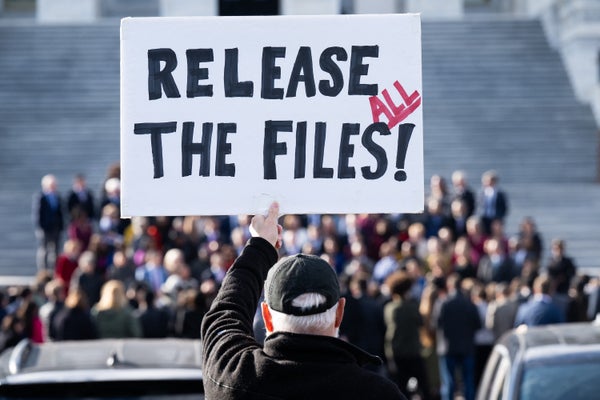
Epstein’s links to President Donald Trump galvanized public attention following the release of these documents from a congressional committee, alongside a move in Congress to force the release of files related to the late financier from the Department of Justice. But the new release also highlighted how Epstein, who died while awaiting trial in 2019, had, for years, been deeply involved in science. His already known involvement included making a $6.5-million donation to Harvard University’s Program for Evolutionary Dynamics and being invited in 2014 to Scientific American editorial meetings.
The newly released e-mails also contain numerous communications between Epstein and well-known scientists and academics, among them astronomer Lawrence Krauss, economist and former secretary of the treasury Lawrence Summers and linguist Noam Chomsky, who corresponded with Epstein even after his 2008 conviction for sex crimes.
On supporting science journalism
If you're enjoying this article, consider supporting our award-winning journalism by subscribing. By purchasing a subscription you are helping to ensure the future of impactful stories about the discoveries and ideas shaping our world today.
Krauss is a former member of Scientific American's board of advisers; he was removed from the board in 2018 following allegations of sexual misconduct. The records show that Krauss, author of the best-selling 1995 book The Physics of Star Trek, exchanged more than five dozen e-mails with Epstein, who was a financial supporter of Arizona State University’s Origins Project when it was led by Krauss. The messages reportedly include an e-mail from Krauss, dated to 2018, in which he asked Epstein for advice on how to address sexual misconduct charges the astronomer then faced at Arizona State University, according to science journalist Dan Garisto. Epstein apparently suggested, “Break the charges into ludicrous. ogling. jokes. . etc.”
According to the e-mails, in 2015 Epstein told Chomsky, a renowned linguist and media critic, “You are of course welcome to use apt in new york with your new leisure time, or visit new Mexico again.” The Wall Street Journal later raised questions about the two men’s financial ties. Summers, a former president of Harvard, “corresponded routinely” with Epstein, the New York Times noted on Wednesday.
Epstein’s donations to scientific researchers were unlikely to have exceeded a few tens of millions of dollars, Science magazine estimated in 2019. Epstein told the magazine in 2017 that he favored “rebel” scientists and criticized institutions such as the MacArthur Foundation as too “politically correct.” His interests aligned with the genetic basis of human behavior, wrote science historian Naomi Oreskes in 2020 in Scientific American, a eugenics-influenced view that is seeing a revival today among some Silicon Valley voices.
“The Epstein affair brings to light a much larger problem,” Oreskes wrote at the time. “It undermines the integrity of the research enterprise when individuals can pick and choose lines of inquiry that appeal to them simply because they can pay for them.”