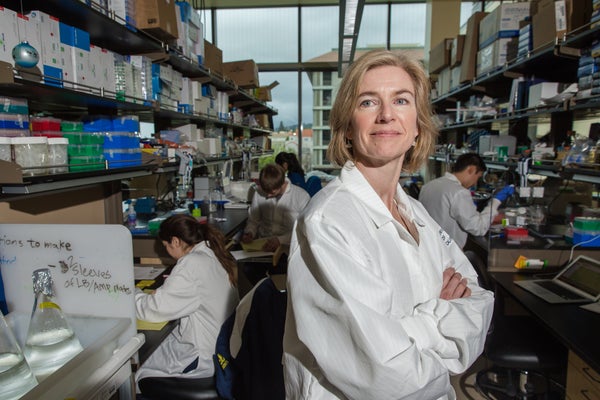
Jennifer Doudna is a biochemist at the University of California, Berkeley, whose research focuses on RNA and genome engineering. She shared the 2020 Nobel Prize in Chemistry with Emmanuelle Charpentier for developing CRISPR-Cas9 as a method for genome editing.
[This interview was edited for length and clarity.]
How would you describe the current state of American science?
On supporting science journalism
If you're enjoying this article, consider supporting our award-winning journalism by subscribing. By purchasing a subscription you are helping to ensure the future of impactful stories about the discoveries and ideas shaping our world today.
The discoveries have never been more promising, but the environment for advancing science in the U.S. has rarely felt more uncertain. In my own field, we designed a personalized gene editing therapy for a patient in just six months, so there’s excitement and momentum. At the same time, researchers across the country are having to spend more time worrying about whether their grants will survive than thinking about their next experiment. That’s corrosive, and it’s happening while the rest of the world is accelerating investment in exactly the fundamental research we pioneered.
What needs to change in American science?
We need to treat scientific research as fundamental infrastructure, not a budget line to cut. Every dollar the National Institutes of Health invests returns roughly two and a half dollars to the economy, and that’s been a consistent return on investment for decades. We also need new models for translational science, the work that turns a lab discovery into something a patient or farmer can actually use. At the Innovative Genomics Institute [IGI], we’ve used philanthropic capital to derisk science that’s too early for venture funding. In 10 years, with a mix of federal, state and philanthropic funding, IGI research has spun out 30 companies that have raised more than $5 billion and created 2,500 jobs. But most researchers don’t have access to philanthropic funding, and if science relies on philanthropy to derisk early research stages, we’re going to miss a lot of discoveries.
What gives you optimism right now?
A baby named K.J., born with an ultrarare disease with no treatment and a 50 percent infant mortality rate. A team of scientists designed a personalized CRISPR therapy from scratch, delivered it in six months, and the FDA reviewed it in one week. K.J. is home, thriving, taking his first steps. That happened because of a long chain of publicly funded, curiosity-driven research. We’re now working to scale that approach to reach hundreds of children with rare diseases. Beyond medicine, I’m excited about using CRISPR to engineer microbiomes, which could transform agriculture and climate. Also, the convergence of artificial intelligence and gene editing is accelerating key aspects of the work and helping us run fewer experiments but the right ones.
What’s your best advice for an early-career scientist?
Follow the question you can’t let go of, even if others don’t think it matters yet. CRISPR came from studying an obscure bacterial defense mechanism. Also, don’t underestimate who you might end up working with. My most important scientific partnership started with a walk through the streets of San Juan with Emmanuelle Charpentier. We came from completely different backgrounds, and that’s exactly why the collaboration worked. The best ideas often come from people who haven’t yet been told that something isn’t possible.
How has your field changed in the past few years?
CRISPR has evolved from a lab tool into a technology that underpins a new era of medicines treating real patients, with one medicine approved and dozens more in clinical trials. AI is transforming how we do the science itself, from designing guide RNAs to modeling DNA sequences with unprecedented accuracy. The field has also expanded well beyond human health into agriculture and climate change, with disease-resistant and drought-resistant crops in field trials and a $70-million initiative to engineer the microbiome. What started as a gene-editing tool is becoming a platform for taking on some of the toughest challenges that humanity faces.