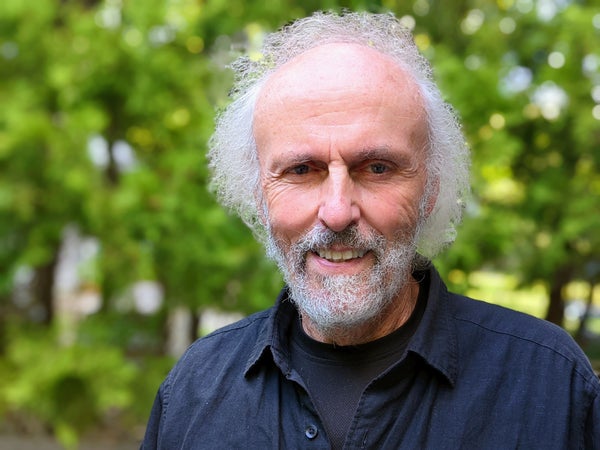
John Allen Paulos is professor emeritus of math at Temple University, where he studies probability theory and logic. He is also author of several popular books on math in society.
[This interview was edited for length and clarity.]
How would you describe the current state of American science?
On supporting science journalism
If you're enjoying this article, consider supporting our award-winning journalism by subscribing. By purchasing a subscription you are helping to ensure the future of impactful stories about the discoveries and ideas shaping our world today.
That’s a very big question, and I have a very small answer, which is: it’s hard to say. I mean, there are some political [people who] are alive today, and that of course impacts American science, from, for example, RFK, Jr., [Secretary of Health and Human Services Robert F. Kennedy, Jr.] and the National Institutes of Health. But also, there are just the political, antiintellectual, antiscientific movements that are worrisome. So it’s not clear what impact that will have on working scientists, but it does create an environment that is not conducive to science. And that's unfortunate.
How has your field changed in the past few years?
In mathematics, everything I just said doesn’t apply. Because mathematical research is so esoteric, in a sense, and isn’t even tangential to hot-button emotional issues. Most people can’t relate to them, so therefore antiscientific types just say, “Well, what’s math? You just add big numbers.”
Math is blooming. There are all kinds of new results in a variety of fields, and there’s also the burgeoning interplay between parts of mathematics and parts of artificial intelligence. And trying to get some kind of understanding of that is an ongoing effort. Mathematics is thriving, and it’s independent of political and other antiscientific kinds of movements.
What needs to change in American science?
What would help would be a general culture that not just superficially reveres science and math but actually does support them and does to some limited extent understand them. And that is more a political, social issue than it is either math or an aspect of various sciences, and it seems to have changed or diminished in recent years.
I mean, we go around the moon, and yet people and all these websites, even news websites, have a silly argument or a silly article on this or that aspect of astrology. Even just informally, people would say, “Oh, you used to say that, but now you say this.” Things have changed, and now, you know, there is a resistance to logic and sometimes a glorification of blind faith that is more prevalent now than it has been in recent years.
I keep going back to the same issue that the problem isn’t mathematics or science or mathematicians or scientists but the general culture, which, despite superficially revering these subjects, actually dismisses them as uninteresting. And what’s interesting is whatever hot-button issue is being discussed, regardless of it being discussed very loosely and without much understanding of the issue itself.
What gives you optimism right now?
What gives me optimism is that smart people are still drawn to science, the whole panoply of disciplines. I’d like to hope that this is a part of human nature, [having] this curiosity and seeing the relevance of this or that scientific or mathematical breakthrough to their lives. Curiosity and appreciation for usefulness and for beauty are, I like to think, unkillable human attributes. And so, no matter what the political situation is, I think most people still feel that—maybe not the most vocal of people but most people.
What's your best advice for early-career scientists?
Yeah, I would say: have a broad background. I got a Ph.D. in math, but as an undergraduate, I majored for a while in English and philosophy. And these have put me in a good position to appreciate mathematics generally. Take courses outside your science major as an undergraduate. Don’t specialize too much. Just have a broader approach, not just in mathematics but toward intellectual disciplines in general.
How has your field changed in the past few years?
Well, this movement towards using AI in parts of mathematics has grown much stronger. I mean, not that long ago, most mathematicians had a kind of dismissive attitude toward AI. In general, [in] certain areas of mathematics, the reliance on AI is growing significantly. I think this kind of narrow-minded, myopic view of mathematics as just hemi-semi-demi-loops of order seven, even if they are somebody’s specialty, is less tenable now. People are searching for, I think, broader meaning. It’s a good change for mathematics, but it does have a dispiriting aspect. Why would you spend X years getting to be a master of this or that when who knows what new advance in AI will prove all the theorems I spent my career trying to prove. So, I mean, that’s a good thing. It’s nice to get results, not just in math but [in] science. But there are lots of caveats.