
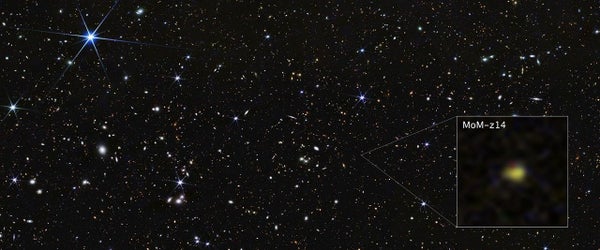
In a galaxy far, far away, there lie clues to the cosmic dawn—the first few hundreds of millions of years in our 13.8-billion-year-old universe’s early history. On Wednesday astronomers on announced that a bright galaxy called MoM-z14 that was found using NASA’s James Webb Space Telescope (JWST) is the farthest yet detected, existing just 280 million years after the big bang.
“With Webb, we are able to see farther than humans ever have before, and it looks nothing like what we predicted, which is both challenging and exciting,” said Rohan Naidu, an astronomer at the Massachusetts Institute of Technology and the lead author of a preprint paper detailing MoM-z14’s discovery that will soon be published in the overlay journal Open Journal of Astrophysics, in a statement in NASA’s announcement.
The galaxy, the light of which has taken more than 13 billion years to reach our telescopes, is brighter, denser and more chemically rich than astronomers had expected, according to NASA.
On supporting science journalism
If you're enjoying this article, consider supporting our award-winning journalism by subscribing. By purchasing a subscription you are helping to ensure the future of impactful stories about the discoveries and ideas shaping our world today.
To pinpoint galaxies like MoM-z14, astronomers use redshift. Essentially, this is the measure of how stretched the light coming from an object is as a result of that object moving away from our perspective as the universe expands. The higher the redshift, the farther the object is. In MoM-z14’s case, it has a redshift of 14.4—a record, Scientific American columnist Phil Plait noted late last year.
But records are made to be broken. And NASA said it fully expects this new JWST achievement to be surpassed in the not-too-distant future as its observations improve.
Regardless, MoM-z14 could offer new clues to the early universe, including, for instance, why it and other early galaxies are so bright.
“It’s an incredibly exciting time, with Webb revealing the early universe like never before,” said Yijia Li, a Pennsylvania State University graduate student, who also contributed to the research, in the same statement, “and showing us how much there still is to discover.”