
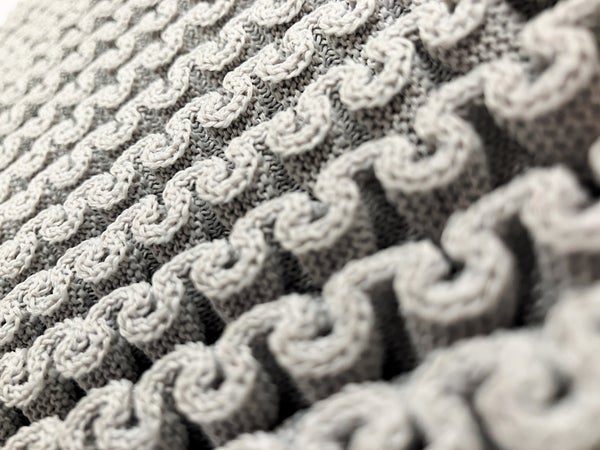
In the core of a knitting machine or at the tips of a skilled knitter’s needles, a strand of fiber can be transformed into anything from a delicate scarf to a bulletproof vest. But different knitting stitches tend to twist in different directions—think of a T-shirt curling at the bottom edge if the hem is cut off. The tension these stitches create can warp a two-dimensional fabric into complex 3D shapes, and predicting the final structure of a knitted project challenges crafters and manufacturers alike. Now a mathematical model published in the Proceedings of the National Academy of Sciences USA uses physics to untangle this issue.
Physicists are always searching for rules that govern materials’ behavior, explains study lead author Lauren Niu, a physicist at Drexel University. Once rules are established, Niu says, “that’s where the magic happens.” Prediction becomes possible.
Niu worked with University of Pennsylvania physicist Randall D. Kamien and Geneviève Dion, founding director of Drexel University’s Center for Functional Fabrics, to find a mathematical model that reliably forecasts a knitted textile’s complicated shapes and folds based on the stitch pattern used.
On supporting science journalism
If you're enjoying this article, consider supporting our award-winning journalism by subscribing. By purchasing a subscription you are helping to ensure the future of impactful stories about the discoveries and ideas shaping our world today.
The researchers started by knitting complex patterns—including squiggles, peaks, and fabric that folded into the shape of a face—and then reverse engineered the knitted items’ geometries. They realized they did not have to account for each stitch’s actual shape and stretch, which would require too much computational power at the necessary scale, to foretell a textile’s final form. Instead they needed to know only how each kind of stitch tended to curve the fabric.
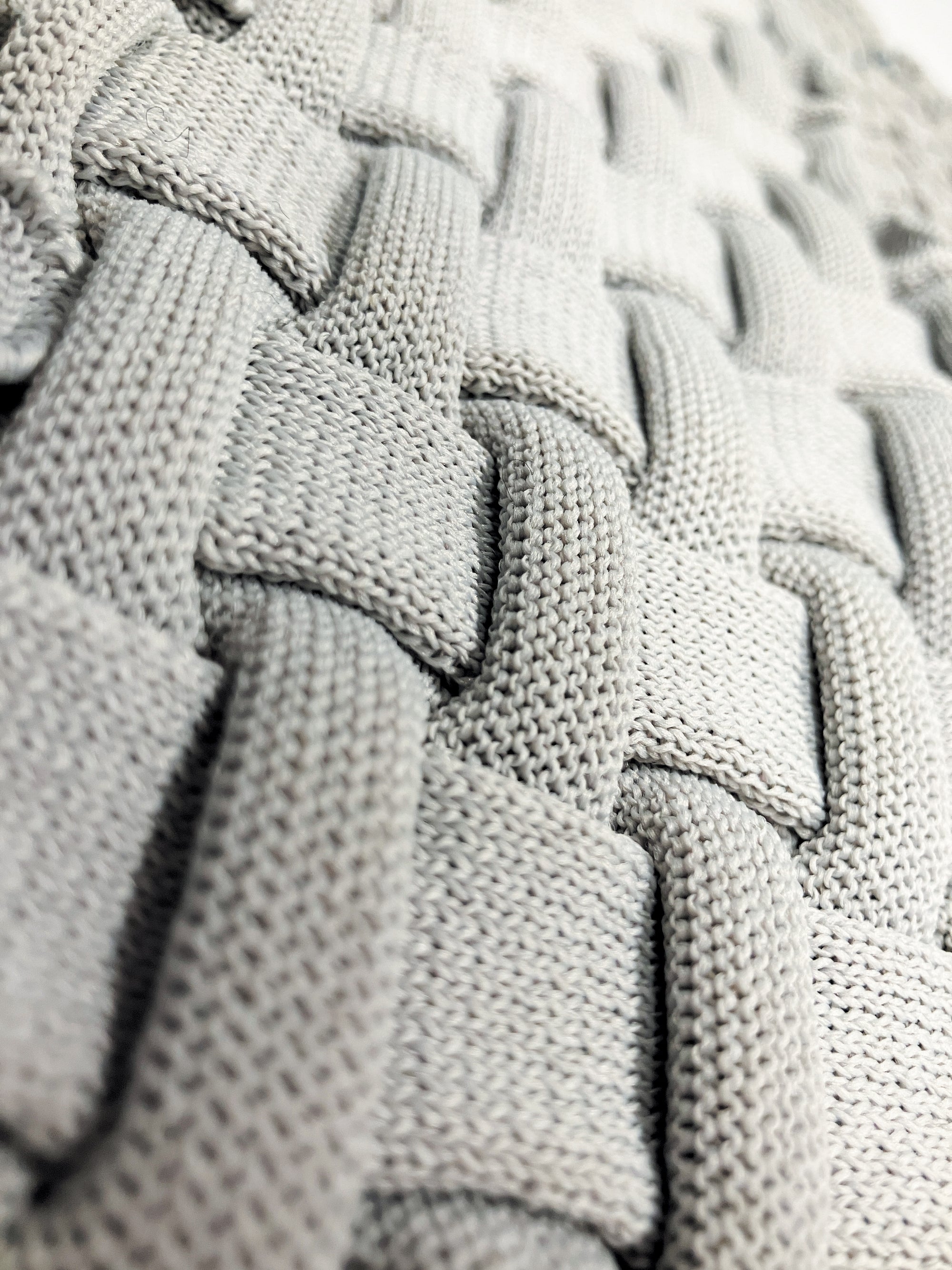
Another test knit shows complex curvature.
Lauren Niu
The new model incorporates information about how stitches produce tension into an intricate mathematical construction called a Föppl–von Kármán equation. These equations describe how thin, flexible materials—such as cellular tissues and submarine hulls—behave under internal and external forces. Mapping knit stitches this way makes it possible to experiment with textile designs before physically knitting the material, Kamien says. He hopes such virtual testing will lead to more advanced, customized textiles for objects such as wearable medical devices.
“Having something that is as incredibly tunable and scalable and cheap as knitting for wearable devices is, I think, very exciting,” says Stanford University mechanical engineer Cosima du Pasquier, who was not involved in the new study. Du Pasquier, who studies soft robotics that use functional textiles, would like to see how the model’s predictions quantitatively line up with real-world fabrics and whether varying factors such as fabric thickness and yarn type affect that comparison.
Even without refinement, the study authors say, the model offers a practical starting point for trying new designs. “You can’t capitalize on [knitting’s] potential if you’re still based on trial and error,” Dion says. “We’re starting to be able to experiment in the virtual environment.”