
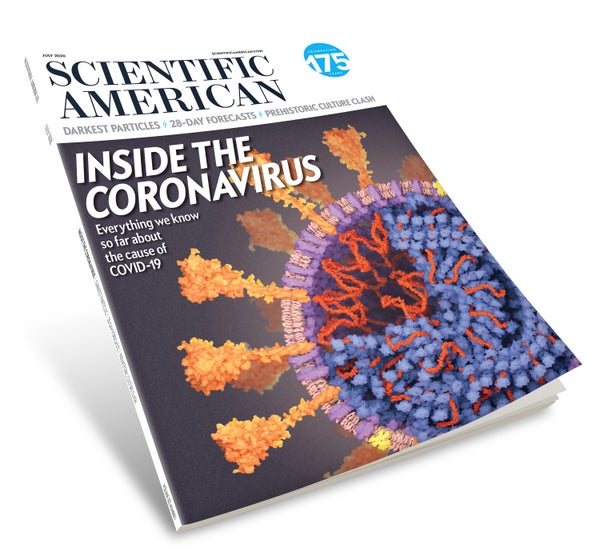
The coronavirus that has killed hundreds of thousands of people and staggered the world's economy is just about 88 nanometers in diameter—138 nm if you count its spikes. In this issue of Scientific American, we show what scientists have learned so far about the structure and function of the evil genius pathogen SARS-CoV-2. Molecular virologist Britt Glaunsinger worked with artist Veronica Falconieri Hays, senior editor Mark Fischetti and senior graphics editor Jen Christiansen to create a detailed 3-D model of the virus and illustrations showing how it invades lung cells and torments the immune system.
The global pandemic has forced us into the largest psychology experiment in history. Researchers are studying the effects of mass isolation, fear and grief and the ways discrimination and poverty make this pandemic even more devastating. Author and contributing editor Lydia Denworth explores what we know about the mental health toll of this crisis and how to promote coping or even resilience during a disaster.
The pandemic amplifies the need for good data in medicine. Writer Virginia Sole-Smith shows that the evidence for obesity as a risk factor for poor health is actually pretty thin. The stigma against large bodies is dangerous in itself, and the focus on weight can lead to misdiagnoses and improper treatments.
The consensus here at Scientific American is that neutrinos are cool. During a stressful time, we all enjoyed working on physicists William Charles Louis and Richard G. Van de Water's article about a possible fourth flavor of neutrino, which could be a key to understanding dark matter and dark energy.
Archaeologists and geneticists are uncovering complex and sometimes disturbing social interactions in ancient Europe, where farming people who migrated from the Middle East may have enslaved or sacrificed hunter-gatherers. Journalist Laura Spinney takes us on their journey.
One of the many ways science saves lives is through forecasting. If we know what's coming, we can prepare for it. (That's the whole point of epidemiological models of how diseases such as COVID-19 spread.) Scientists such as Kathy Pegion are now pushing weather forecasts out to 28 days. See how well her recent weather prediction turned out.
I'm thrilled to join Scientific American as the next editor in chief in our 175-year history. Like you, I've admired and enjoyed the magazine from the outside, and now I am honored to work with the dedicated, knowledgeable, talented, curious and kind staff. I am grateful to our managing editor Curtis Brainard for leading the magazine brilliantly for the past several months and guiding us through the early chaos of the global pandemic. Everyone is working harder than ever, but we are energized by the mission of producing timely, trustworthy and welcoming science stories, graphics, podcasts and videos. You can see all of our COVID-19 coverage online at sciam.com/coronavirusoutbreak.
Thank you for supporting the magazine and being part of the Scientific American community. The pandemic has shown the dangers of misinformation, ignorance and confusion. Together we can elevate sense over nonsense, and perhaps the world will emerge from this crisis with a better understanding of pathogens, public health, the research process and the importance of making decisions based on the best evidence.