
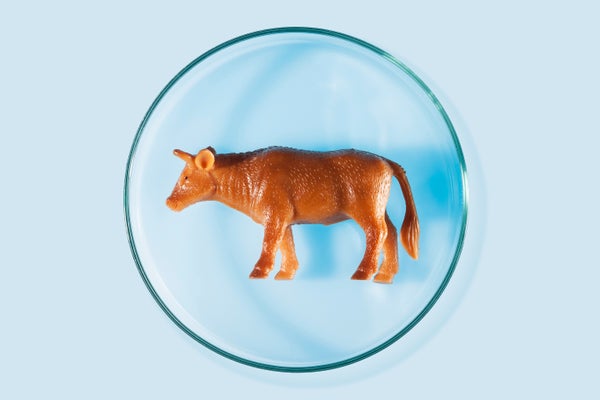
Meat grown in the lab has been hailed as an environmentally friendly, cruelty-free alternative to conventional chops and steaks — but struggles to replicate the taste of the real thing. Now, researchers have engineered cultured meat that releases beefy flavours at high temperatures, a development that could improve its appeal to diners.
In a study published on 9 July in Nature Communications, the team showed that enhancing in vitro animal cells with compounds associated with the Maillard reaction — the process that gives cooked food its darkened colour and appetizing flavours — helps to replicate the aroma, and therefore the flavour, of conventional meat.
“To our knowledge, it’s the first approach to regulate the flavour properties of cultured meat,” says study co-author Milae Lee, a biomolecular engineer at Yonsei University in Seoul.
On supporting science journalism
If you're enjoying this article, consider supporting our award-winning journalism by subscribing. By purchasing a subscription you are helping to ensure the future of impactful stories about the discoveries and ideas shaping our world today.
“There’s not enough research like this, that focuses on this kind of end-product analysis,” says Seren Kell, head of science and technology at the Good Food Institute Europe in Forest, Belgium. It is “really important to make sure that cultivated meat can match consumer expectation”, she adds.
Flavour focus
Cultured meat, which is produced by growing animal muscle cells in the lab, has numerous advantages compared to standard meat. There’s no need to slaughter animals to produce the stem cells the process requires, and manufacturing the meat at scale could eventually have a lower carbon footprint than rearing livestock. “A lot of greenhouse-gas emission is involved to produce conventional meat,” says Lee. “For cultured meat, these kinds of environmental-pollution factors can be minimized.”
Although previous research has explored ways to advance cultured-meat production, mimicking the structures of familiar products such as meatballs, these studies often “don’t really focus on the ‘organoleptic’ — sense — properties, especially flavour and taste”, says Lee.
When conventional meat is cooked at high temperatures, it undergoes the Maillard reaction — its amino acids and sugars react with each other, giving the meat its recognizable aroma and taste. But because cultured meat has a different amino-acid profile to conventional meat, it doesn’t react to the same extent.
To try to rectify this, Lee and her colleagues developed a compound that could be added to cultured meat, containing furfuryl mercaptan — a product of the Maillard reaction known to contribute to a savoury flavour profile — along with substances that would help it to bind to the meat and keep it from breaking down. They engineered the compound to be ‘switchable’, meaning that the flavour would be released when the meat was heated to 150 °C.
They were also keen to ensure that the compound was compatible with the cell-culturing process. They incorporated it into a hydrogel: a jellylike material that can be used as a scaffold for stem cells as they grow into muscle tissue and become more meat-like.
The researchers used an electronic nose — a device that analyses the chemical make-up of smells — to test how well the hydrogel and cell cultures held the flavour. At room temperature, the meat they grew didn’t have much of a flavour. But when heated to 150 °C, it produced compounds associated with savoury, fruity and meaty flavours. This shows that the hydrogel works well with the flavour component to produce a controlled release of meaty aromas.
Further research revealed that a combination of three different Maillard-reaction products provided a flavour even closer to that of conventional beef, with floral and creamy notes alongside more savoury aromas. The team plans to trial other mixtures in future, says Lee. The group is also hoping to scale up the technology — at the moment, the process of making meat in the lab is slow and labour-intensive, and only small quantities are produced.
Kell is keen for the team to explore the potential of different meaty flavours, by “looking at all the dominant flavour compounds in other species and product types, beyond just beef.”
This article is reproduced with permission and was first published on July 10, 2024.