
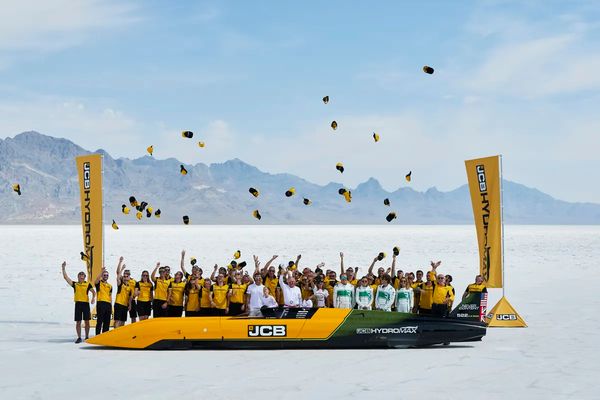
Andy Green is the only person to ever break the sound barrier on land. And on Tuesday he shattered several more speed records, driving faster than anyone ever had officially achieved in a hydrogen-powered or clean-power car.
Driving a highly engineered specialty race car called the Hydromax, which was designed by the construction equipment firm JCB, the retired 64-year-old British fighter pilot made two attempts. In the first, he recorded an average speed of 400.623 miles per hour. And in the second, he hit 412.135 mph. Between the two, his average top seed was 406.320 mph.
Green is best known for holding the current overall land speed record, having hit 763.035 miles per hour while driving a race car powered by jet engines in 1997. That’s not only a record that’s stood for almost 30 years but also the only time a human being has gone faster than sound in a land-based craft.
On supporting science journalism
If you're enjoying this article, consider supporting our award-winning journalism by subscribing. By purchasing a subscription you are helping to ensure the future of impactful stories about the discoveries and ideas shaping our world today.
Tuesday’s race shattered three prior records under the International Automobile Federation (FIA), the global governing body for motorsports: fastest hydrogen internal combustion engine (185.5 mph), fastest hydrogen fuel cell car (303 mph) and fastest electric vehicle (342 mph).
The JCB Hydromax is a blown gas streamliner, a class of race cars that are designed to hit incredibly high speeds on straightaways. “Blown gas” indicates that the car comes equipped with a supercharger that forces more air into the engine, allowing it to burn more fuel.
It’s a vehicle quite unlike anything you’re likely to ever see on the road: it measures 32-feet-long and is equipped with two 800-horsepower engines, one mounted in front of the driver and the other behind them.
Rather than using gasoline or diesel as fuel, the engines use air to ignite hydrogen. That not only powers the engines but creates far less pollution than a traditional internal combustion engine in the process.
“This record was set by production-based engines, the same engines powering JCB diggers right now,” said JCB chairman Anthony Bamford in a statement. “That is the point of JCB Hydromax: it shows hydrogen works, and it works today at the highest level with zero emissions.”
Green set the record on the iconic Bonneville Salt Flats, the Utah salt pan where numerous land speed records have been set in the past. On August 5 the car, once again driven by Green, was recorded traveling at an average of 368.347 miles per hour over two runs, a high mark for the Southern California Timing Association’s blown gas streamliner class. In one of the runs, the Hydromax topped out at 369.554 miles per hour.