
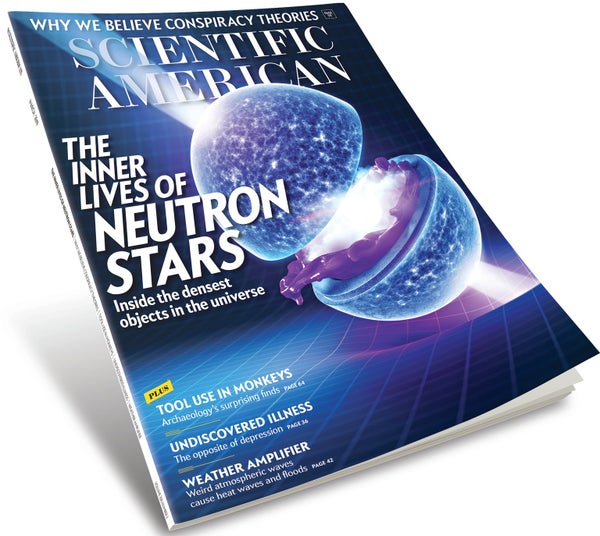
“The most outrageous object that most people have never heard of,” as one scientist calls it, is the subject of our cover story—and, to my mind at least, such amazing adventures in discovery make up a theme that resounds throughout this Scientific American issue, among many others.
What's this intriguing object? In “The Inner Lives of Neutron Stars,” senior editor Clara Moskowitz writes about these strange cosmic things, which pack the mass of roughly two suns into a space no wider than a city. They are born when stars die and collapse on themselves. The extreme density created by stellar cataclysms is the greatest amount allowed naturally in our universe and impossible to come close to approximating in any laboratory on Earth. Understanding the phenomena that result under such conditions is the tantalizing challenge of researchers, who are positioned to gain new insights from detectors capable of measuring gravitational waves from neutron star collisions, along with experiments focusing on these unusual objects.
The human genome's DNA forms some 10,000 wiggling minuscule loops in our cells, which somehow avoid “tangling into a mess” that would disrupt crucial genetic messages. These loops, which turn out to be ancient structures in biology, are involved in gene regulation and may hold clues to how many diseases arise. As geneticist Erez Lieberman Aiden writes, “We and others have figured out how these loops form, dancing an elegant tango that keeps the genome tangle-free.” You can unspool the mystery in his feature, “Untangling the Genome.”
On supporting science journalism
If you're enjoying this article, consider supporting our award-winning journalism by subscribing. By purchasing a subscription you are helping to ensure the future of impactful stories about the discoveries and ideas shaping our world today.
Several stories will take you on fascinating intellectual voyages into the mind and behavior—and not just those of humans. Contributing editor Melinda Wenner Moyer looks at why some people refuse to accept facts and data in “Why We Believe Conspiracy Theories.” “The Undiscovered Illness,” by journalist Simon Makin, explores the question of whether some bipolar patients who experience only mania should have a separate diagnosis. Two articles look at cognitive areas at least partly shared among animals. “The Orca's Sorrow,” by science writer Barbara J. King, finds evidence that a wide variety of animals are capable of mourning. “The Other Tool Users,” by independent researcher Michael Haslam, looks at excavations of stone tools left behind by nonhuman primates and the origin of innovation. And get ready for more extreme summer weather, as expert Michael E. Mann takes us on a tour of the jet stream.