On supporting science journalism
If you're enjoying this article, consider supporting our award-winning journalism by subscribing. By purchasing a subscription you are helping to ensure the future of impactful stories about the discoveries and ideas shaping our world today.
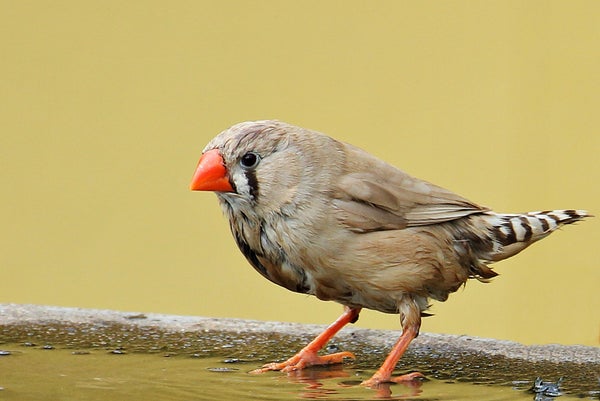
Sometimes the best way to deal with a problem is to sleep on it. That approach appears to be employed not only by people but by songbirds as well. Indeed, according to a report published Friday in the journal Science, zebra finches may very well rely on sleep in order to rehearse their songs.
Amish S. Dave and Daniel Margoliash of the University of Chicago set out to investigate the relationship between motor activity and auditory feedback in songbirds by studying neurons in the zebra finch forebrain during the daytime, while the birds sang. They then observed those same neurons while the creatures were asleep and being exposed to recordings of their songs. They found a strikingly similar pattern. The researchers say this similarity suggests that the birds will file away a song that they¿ve heard and practice it "off-line" while snoozing.
"Our observation of neuronal replay of sensorimeter patterns during sleep studies," they write in their report, "is consistent with data from hippocampal studies suggesting that sleep is important for the consolidation of neuronal temporal codes for spatial memory."
Subscribe to Support Independent Journalism
Great science journalism requires human expertise, time, effort and creativity. And it costs money. That’s why I and the journalists here at Scientific American hope you’ll join our community.
When you subscribe, you are supporting staff and freelance journalists who are passionate about telling science stories that are true, important and compelling. Our editors and reporters are often experts in their fields, which means they understand the nuances of big discoveries and can untangle the breakthroughs from the hype. With a subscription, you are also supporting rigorous fact-checking to ensure the words we publish are precise and accurate. And you’re supporting original illustrations, graphics and photos that bring you closer to an advanced laboratory, an ice sheet in Antarctica or a space mission in orbit. You’re helping us craft other types of high-quality journalism as well: Our newsletters are carefully written, edited and curated by staffers you have or will come to know and love. Our Science Quickly podcast is based on original reporting, collaboration with editors and scientists and exacting production.
Subscriptions keep this engine running so we can continue to deliver thoughtful, rigorous and independent science journalism to you. In an era of viral misinformation, this work is crucial. If you value what we do, I hope you’ll consider joining us as a subscriber