
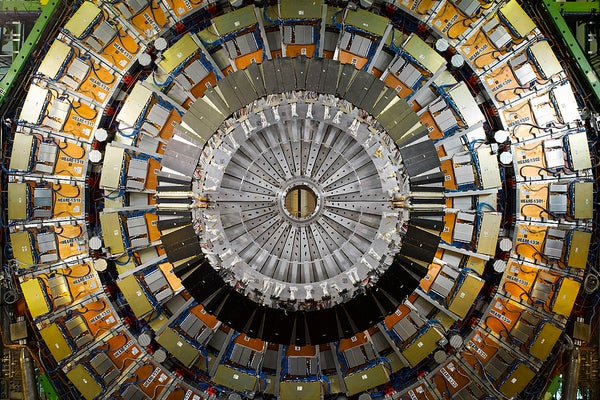
Physicists using the Large Hadron Collider beauty (LHCb) experiment at CERN in Geneva, Switzerland, have discovered a new kind of heavy particle, they announced this week at a conference in Venice.
The particle, known as Xi-cc++ (pronounced “Ksī-CC plus-plus”), is composed of three smaller elementary particles called quarks—specifically, one lighter-weight “up” quark like those found in protons and neutrons as well as two “charm” quarks, which are a heavier and more exotic variety. (The designations “up” and “charm” are two of the six “flavors” physicists assigned to quarks based on the particles’ varying masses and charges.) The Standard Model of particle physics predicts Xi-cc++ and many other possible particles with various configurations of the six known flavors of quarks. But until now such “doubly charmed” particles had eluded conclusive detection. Further studies of the new particle—and other members of the doubly charmed particle family—could reinforce the Standard Model or lead to new vistas in particle physics. Either way, the new particle could be a tool to unlock a deeper understanding of the fundamental “strong” force that binds quarks together to form protons and neutrons, which in turn form atoms—as well as planets, stars, galaxies and people.
Any particle made of quarks is called a hadron. The world’s largest and most powerful particle accelerator, CERN’s Large Hadron Collider (LHC), slams these particles together in search of new particles and interactions. Hadrons fall into two broad families: mesons, exotic particles with one quark and one antiquark; and baryons, particles composed of three quarks. The new Xi-cc++ particle is a baryon. But due to its doubly charmed nature it is almost four times heavier than more familiar baryons such as protons and neutrons, which are made up entirely of light quarks rather than heavy ones. “Finding a doubly heavy quark baryon is of great interest, as it will provide a unique tool to further probe quantum chromodynamics [QCD]—the theory that describes the strong [force], one of the four fundamental forces,” LHCb spokesperson Giovanni Passaleva said in a statement. “Such particles will thus help us improve the predictive power of our theories.”
On supporting science journalism
If you're enjoying this article, consider supporting our award-winning journalism by subscribing. By purchasing a subscription you are helping to ensure the future of impactful stories about the discoveries and ideas shaping our world today.
The featherweight quark triplets within protons and neutrons all uniformly zip around one another at nearly the speed of light, making them very challenging to study. In a Xi-cc++ particle, the sole light quark whips at high speed around the heavier, slower-moving heavy quark pair, creating a situation easier for physicists to investigate. The situation, says former LHCb spokesperson and University of Oxford physicist Guy Wilkinson, is roughly analogous to a planetary system in which the light quark is akin to a planet orbiting a binary pair of massive stars.

Credit: Amanda Montañez
Led by University of Glasgow physicist Patrick Spradlin, the LHCb team found evidence of more than 300 of the new particles in data collected last year by the experiment, teasing out their signals from a dense forest of more common particles produced by high-energy proton collisions at the LHC. Specifically, they looked for a telltale distribution of “daughter” particles, including other baryons as well as kaons and pions—exotic particles produced by the decay of short-lived Xi-cc++ particles. The distributions they observed show not only that the LHC’s collisions are producing Xi-cc++ particles but also hint that other researchers’ previous claims of double-charm particle production may be spurious.
In 2002 researchers using the SELEX experiment at the Fermilab accelerator in Illinois announced they had found a similar particle. That detection, however, was just below the threshold of unassailable statistical significance, and the putative particle’s estimated mass was wildly out of sync with predictions. After other facilities failed to confirm the results, many theorists began questioning the claim. By contrast, the signal of the LHCb’s newfound particle “is statistically overwhelming and matches very nicely with the theoretical expectations,” Wilkinson says. “It looks, smells and tastes like a doubly charmed baryon should.” The LHCb team’s findings have been submitted to Physical Review Letters.
With the detection of the new, heavy particle firmly in hand, physicists at the LHC are now producing more of these particles to precisely measure their lifetimes and learn exactly how often they are created in collisions. Next, Wilkinson says, the LHCb experiment will seek out other postulated members of the doubly charmed family, such as the Xi-cc+ and Omega-cc particles. “All these results can be compared against predictions to test QCD,” he says. “There are exciting times ahead!”