
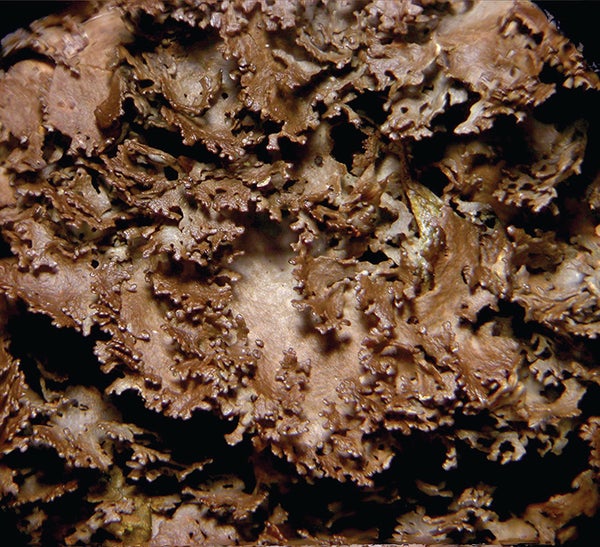
As a result of climate change, saltwater is predicted to soon swallow much of a North Carolina swamp forest and its biodiversity. But certain denizens of Alligator River National Wildlife Refuge might get a ticket out in time. Some of the lichens that embellish local tree bark there could be carefully plucked and transported to a new habitat under a plan now being developed by a team of lichenologists.
The stakes are high for some of these unusual organisms. Almost all the known living individuals of dey's moon lichen, Sticta deyana (above), are found within several square miles of the refuge, and other rare and endemic lichen species there are in jeopardy as well. Saltwater inundation eventually kills coastal forests in low-lying areas such as the swamp forests of the Alligator River region, so relocation may be the only way to save many of the resident lichens.
Without help, about half the area's lichen population will likely be lost within five decades; the rest could disappear in the five decades after that under a worst-case climate scenario. In an effort to intervene, James Lendemer, an assistant curator and lichenologist at the New York Botanical Garden, and a colleague are mapping out an ambitious plan for physically relocating entire communities of the area's lichens.
On supporting science journalism
If you're enjoying this article, consider supporting our award-winning journalism by subscribing. By purchasing a subscription you are helping to ensure the future of impactful stories about the discoveries and ideas shaping our world today.
Lichens comprise a symbiotic partnership involving fungi, algae and sometimes cyanobacteria. They provide shelter for spiders, nematodes and moths, as well as food for voles, caribou and other ungulates. They also help to regulate microclimates and keep humidity levels steady by absorbing the water from fog, dew and rain, then later releasing it within a forest canopy.
From 2012 to 2016 Lendemer and Jessica Allen, a researcher at the botanical garden, documented a rich biodiversity of lichens, including dey's moon, stretching from southern New Jersey through South Carolina. The team has already mapped possible assisted migrations of lichens in the Mid-Atlantic Coastal Plain and has conducted some successful tests of transplant methodologies for a number of lichen species within the southern Appalachians. Allen used forceps to carefully remove lichens from their habitats and place them onto surfaces such as burlap, gauze and plastic mesh for transport. Now the team is studying ways to transplant lichen communities from imperiled habitats, among them the swamp forests of the Mid-Atlantic Coastal Plain, to nearby preserves or to other parts of a species' previous range. The team's results were most recently detailed in the October 2016 issue of Biological Conservation.
Lichenologists have transplanted individual specimens in the past—but efforts to relocate entire lichen communities represent a new conservation approach for these organisms, says Christopher Ellis, a lichenologist at the Royal Botanic Garden Edinburgh. Lichens benefit collectively from each individual's work to establish ideal conditions, such as a certain humidity level. Thus, moving multiple species that belong to a community is key to their long-term survival. Progress with collective transplants in North America might inspire similar efforts along parts of Scotland's coast. Conservation biologists could move coastal lichens from shorelines to restored habitats, Ellis notes, as Scotland embarks on an ambitious “managed retreat” initiative to counter the squeeze of rising seas.