

The following essay is reprinted with permission from The Conversation, an online publication covering the latest research.

How chemical reactions on a lifeless planet floating around in the cold darkness of space can suddenly give rise to living organisms is one of the biggest questions in science. We don’t even know whether the molecular building blocks of life on Earth were created here or whether they were brought here by comets and meteorites.
On supporting science journalism
If you're enjoying this article, consider supporting our award-winning journalism by subscribing. By purchasing a subscription you are helping to ensure the future of impactful stories about the discoveries and ideas shaping our world today.
Using data from the NASA/ESA Cassini mission, we have now discovered molecules on Saturn’s largest moon Titan which we think drive the production of complex organic compounds. These are molecules that have never been seen in our solar system before. The discovery not only makes Titan a great contender for hosting some sort of primitive life, it also makes it the ideal place to study how life may have arisen from chemical reactions on our own planet.
The molecular building blocks of life are organic compounds including amino acids that can be assembled into proteins, RNA and DNA in living cells. To date, scientists have found these compounds in meteorites, comets and interstellar dust. But the problem is that these materials formed millions of years ago, which means we have no way of knowing how they were created.
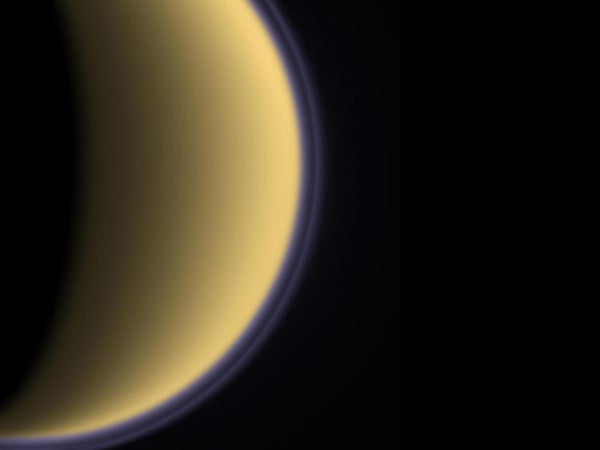
Excitingly, it seems these compounds are being created on Titan today. Sunlight and energetic particles from Saturn’s magnetosphere drive reactions in the moon’s upper atmosphere, which is dominated by nitrogen, methane and hydrogen. These lead to larger organic compounds which drift downwards to form the moon’s characteristic “haze” and the extensive dunes – eventually reaching the surface.
To make these surprising discoveries, published in the Astrophysical Journal Letters, the Cassini spacecraft dipped through Titan’s upper atmosphere. Using data beamed back to Earth, we identified the presence of negatively charged molecules called “carbon chain anions”. These appear to “seed” the larger organic compounds observed at the moon – such as polyaromatic hydrocarbons and cyanopolynnes – which could serve as key ingredients for early forms of life. Laboratory experiments have also shown that amino acids could exist there, but the instruments on Cassini are not equipped to detect them.
Negatively charged molecules like these are rare in space environments as they want to react and combine with other molecules – meaning they can be quickly lost. When present, however, they appear to be a crucial “missing link” between simple molecules and complex organic compounds.
So could life currently exist on Titan? It’s not impossible. Water plumes erupting from another of Saturn’s moons, Enceladus, provides a key source of oxygen, which rains down onto Titan’s upper atmosphere. Titan has even been judged the most likely place beyond the Earth to host life by the Planetary habitability index. But life there would likely be quite primitive due to the cold conditions. The presence of liquid methane and ethane seas also means potential organisms would have to function quite differently to those on Earth.
Tracing life on Earth
Remarkably, similar processes are observed in vast molecular clouds beyond our solar system, where stars are born. After the first stars in the universe entered their death throes and fused together heavier elements, rich organic chemistry took place. In these environments, negatively charged molecules have been shown to act as a catalyst for the formation of larger organics, which could then be transferred to solar systems and comets forming from the cloud.
Complex interstellar chemistry has led to the theory that the building blocks of life could have been delivered to Earth from comets which once formed in these molecular clouds. ESA’s Rosetta mission detected the amino acid glycine when visiting Comet 67P/Churymov-Gerasimenko. However, the new discovery makes it entirely possible that the process of creating life from simple molecules took place on Earth instead.
Titan’s dense nitrogen and methane atmosphere is similar to the early Earth’s, some 2.5-4 billion years ago. At this time, before the build-up of oxygen occurred, large quantities of methane resulted in organic chemistry similar to that observed at Titan today. The moon is therefore a high priority target in the search for the beginnings of life.
By making long-term, detailed observations of Titan, we may one day be able to trace the journey from small to large chemical species in order to understand how complex organic molecules are produced. Perhaps we may even be able catch the sudden change from complex organic molecules to living organisms. Follow-up observations of Titan’s atmosphere are already underway using powerful ground-based telescopes such as ALMA. Further missions to explore Titan are also in the works – it is crucial that these are equipped to detect the signatures of life.
Universal driver
The fact that we now see the same chemistry occurring at Titan as in molecular clouds is fascinating, as it indicates the universal nature of these processes. The question now is, could this also be happening within other atmospheres rich in nitrogen and methane, such as at Pluto or Neptune’s moon Triton? What about the thousands of exoplanets discovered in recent years, circling nearby stars?
The concept of a universal pathway towards the building blocks of life has implications for what we need to look for in the onward search for life in the universe. If we detect the molecules just seen on Titan in another environment, we would know that much larger organics and therefore amino acids are likely to exist there.
Future missions, such as NASA’s James Webb Space Telescope and ESA’s exoplanet mission Plato, are set to further study these processes within our solar system and at planets orbiting nearby stars. The UK is even planning its own exoplanet mission, Twinkle, which will also search for signatures of organic molecules.
Although we haven’t detected life itself, the presence of complex organic molecules at Titan, comets and within the interstellar medium means we are certainly coming close to finding its beginnings. And it’s all thanks to Cassini’s near 20-year exploratory journey. So spare a thought for this magnificent spacecraft as it ends its mission in September with a final death-plunge into Saturn’s atmosphere.
This article was originally published on The Conversation. Read the original article.