
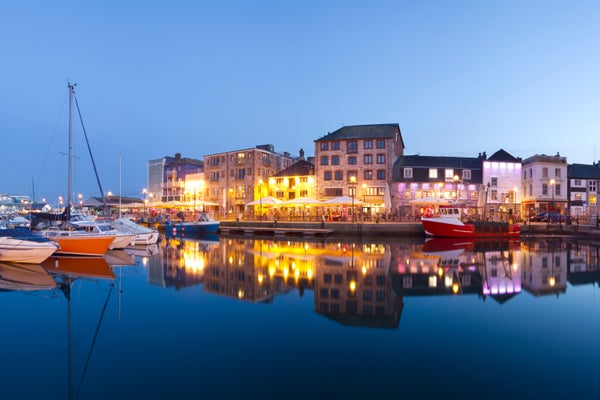
On a moonless night, a team of researchers boarded a rigid inflatable boat in the coastal city of Plymouth, England. As they left the illuminated city about three kilometers behind them and entered the darkness of the River Lynher, the notion that light pollution could reach deep below the water’s surface seemed dubious at first. But the scientists soon realized the sky was not so dark after all. “We could see the light from the city being reflected across all the clouds all the way up, right above us, right over [the] top of us and off into the distance,” says Thomas Davies, a marine conservationist at the University of Plymouth. In that moment, he says, the extent of the light pollution in the area “really hit home” for him and his team.
Artificial light at night has long been suspected to disturb ecosystems on land and affect human health. Light from cities and ships also repels or attracts many species of fish, stresses coral reefs and disrupts the circadian rhythms of wood lice on sandy beaches. But Davies says he and his colleagues are the first to quantify the light pollution that reaches the seafloor near coastal cities. They foundthat as much as three quarters of the seabed in the Plymouth Sound and Tamar Estuary is bathed in artificial light bright enough to impact the ecosystem. The results appeared in July in Scientific Reports.
“It’s about time that we start looking at [light pollution] from a seafloor perspective,” says Jørgen Berge, a marine biologist at UiT–the Arctic University of Norway. “Its importance is much bigger than the attention it actually receives.” Berge studies how marine animals above the Arctic Circle respond to light pollution and was not involved with the new study.
On supporting science journalism
If you're enjoying this article, consider supporting our award-winning journalism by subscribing. By purchasing a subscription you are helping to ensure the future of impactful stories about the discoveries and ideas shaping our world today.
Davies and his colleagues measured the artificial light both above and below the water’s surface using oceanographic radiometers mounted on their boat. Combining their measurements with well-established models of how light travels through the water column, the researchers were able to determine how much blue, green and red light would reach the seabed. Humans’ relatively weak eyesight would not discern artificial light at those depths. But many marine creatures have evolved “incredible sensitivity” to light, Davies says. For instance, tiny crustaceans called copepods migrate vertically each day in response to moonlight, which they can detect more than 80 meters below the surface.
In their analysis, the researchers considered any level of light that copepods can detect to be potentially biologically significant. They found that on cloudy nights, significant green light would reach 76 percent of the seafloor’s area at low tide, while blue would reach 70 percent. On cloudless nights, those numbers dropped to 46 and 43 percent, respectively. “It’s brighter in cloudier conditions because more of the light of the city is being reflected back to the ground by the clouds,” Davies says.
In both cloudy and clear conditions, biologically significant red light penetrated down to less than 1 percent of the seafloor, mainly because those wavelengths attenuate faster in water than green and blue light do. Compounding the effect, copepods and other marine organisms tend to rely more on green and blue light and do not detect red light as easily.
Although the study focused on one city, scientists expect the results in coastal communities worldwide to be similar or worse. Raz Tamir, a light pollution researcher at Tel Aviv University, who was not involved with the new work, notes that estuaries tend to be clouded with sediment. And Davies’s study coincided with a bloom of phytoplankton that may have decreased the amount of light reaching the seafloor. (The bloom was included in the study’s model.) In the coral reef systems that he studies, Tamir says, the water’s clarity could cause up to 100 percent of the seabed to be exposed to detrimental artificial light.
Now that Davies and his colleagues have established the need for studying light pollution on the seafloor, “we’re trying to expand our modeling process up to a global scale so that we can better understand the global distribution of artificial light,” he says.
Complementing these efforts are studies of how light pollution affects individual species, as well as ecosystem-wide interactions. In the lab, Davies is investigating how animals such as crabs, barnacles and mussels respond to artificial light. And he is a member of a new international collaboration, called the Global Artificial Light Ocean Network (GLOW), that plans to measure light pollution’s effects on coastal algae and invertebrates. The researchers intended to begin measurements this year but have been unable to do so because of the COVID-19 pandemic, says Cristián Duarte, a GLOW collaborator and marine biologist at the Andrés Bello National University in Chile.
As coastal cities continue to grow—more than one billion people are projected to live in coastal areas by 2060—light pollution will likely increase, too. The transition from yellow incandescents to white LEDs exacerbates the problem because the latter contain more of the blue and green wavelengths that can penetrate deep in the water, Davies says.
Davies encourages people to ask themselves four questions when deciding how to use artificial light: “Firstly, do I need it? Secondly, how much of it do I need? Thirdly, when do I need it? And fourthly, what color can it be?” These considerations, he hopes, will help communities mitigate the harmful effects of light pollution.