
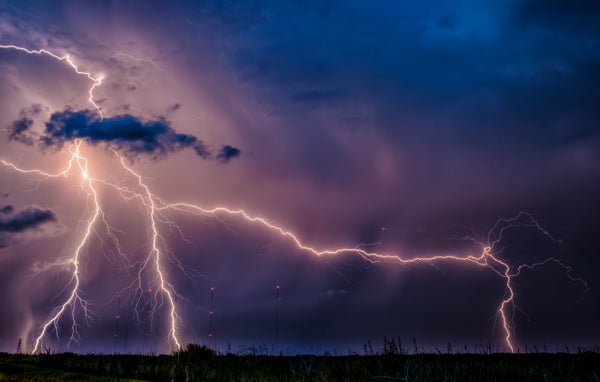
A scientist on the hunt for extraordinarily long lightning bolts has discovered that the storms capable of producing these so-called megaflashes—which can strike without warning under a clear blue sky—tend to be long-lived and travel great distances.
That’s according to research published last month in Earth and Space Science, which analyzed four and a half years of satellite data to look for the characteristics of storms that produce megaflashes: streaks of lightning that stretch at least 100 kilometers (62 miles) long.* The research found that these storms are even more impressive than scientists had thought. “Some thunderstorms actually are able to produce more megaflashes than we expected, even up to a few thousand, over the course of their life history,” says the study’s author Michael Peterson, an atmospheric scientist at Los Alamos National Laboratory in New Mexico.
Peterson has long been studying individual megaflashes, but he wanted to try to understand the phenomenon more generally. Key to that endeavor was a satellite called GOES-16, which has watched over the eastern Americas for the National Oceanic and Atmospheric Administration since the end of 2017. GOES-16 carries an instrument called the Geostationary Lightning Mapper (GLM), which is designed to look for flashes of light across a huge swath of Earth.
On supporting science journalism
If you're enjoying this article, consider supporting our award-winning journalism by subscribing. By purchasing a subscription you are helping to ensure the future of impactful stories about the discoveries and ideas shaping our world today.
“You see a static picture of the Earth, day in, day out, and you can just sit there loitering, recording everything you see,” Peterson says of GOES-16’s position in what is called geostationary orbit, meaning it stays over the same spot on the planet. “This is always on, so regardless of whether [a megaflash] happens once every 1,000 flashes, once every million flashes, once every 10 million flashes, eventually you have a pretty good chance of detecting it,” he says. “That’s when the real big things and real rare things come out.”
By analyzing the GOES-16 data, Peterson found that these storms tend to be born in what scientists call a mesoscale convective system, or MCS. “It’s basically a bunch of thunderstorms that congeal into either a line that stretches for hundreds of miles—or what we call a ‘blob,’” says Timothy Logan, an atmospheric scientist at Texas A&M University, who was not involved in the new research.
Scientists already knew that megaflash-producing storms are particularly likely to form in the North American Great Plains, as well as in South America’s Río de la Plata Basin, and the study confirmed that. But the new research established that only about 1 percent of all thunderstorms trigger megaflashes—and of that set, about 40 percent make only one of these massive bolts. But other storms specialize in megaflashes, producing hundreds or thousands apiece, Peterson found. Megaflashes tend to occur late in the course of long-lived storms that have traveled vast distances, the analysis shows.
“One of the highlights of the study is that the author created a new algorithm for identifying those large thunderstorms that produce megaflashes and studied some of the overall features of these thunderstorms,” says Daile Zhang, an atmospheric scientist at the University of Maryland, who was not involved in the new research. “It’s one of the first such studies to my knowledge.”
Studying megaflashes is about more than understanding their extreme nature, scientists say: The superlong lightning also poses a unique threat to people, who may think they’re safe because the sky has cleared locally. But megaflashes can occur under blue skies, with no rain in sight. “They can be a big risk to people on the ground because they can occur farther away from where the majority of lightning occurs,” says Vanna Chmielewski, an atmospheric scientist at the NOAA National Severe Storms Laboratory, who was not involved in the new research.
Chmielewski recommends following what lightning experts call the 30/30 rule: Stay indoors for 30 minutes after you last heard thunder or when thunder is rumbling less than 30 seconds after lightning flashes. “Lightning, even when it’s not raining, can be dangerous,” she says.
*Editor’s Note (7/5/23): This sentence was edited after posting to correct the description of when the study was published.