
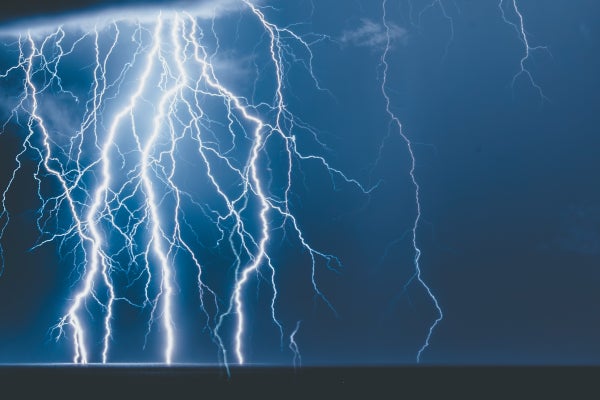
Lightning strikes in the atmosphere can trigger a rain of high-powered “killer electrons” in low-Earth orbit that form harmful streams of radiation, new research suggests. Scientists had previously thought killer electrons might appear only in our planet’s distant outer radiation belt, but a study in Nature Communications finds that lightning nudges them loose in the much closer inner belt, too.
“These high-energy particles are damaging to spacecraft and also to humans in space,” says study co-author Lauren Blum, an astrophysicist at the University of Colorado Boulder. “Knowing when there are very high-energy electrons in the inner radiation belt would be helpful to know when to avoid it.”
Electron precipitation occurs when charged particles, held in place by Earth’s magnetic field, are dislodged from stasis in one of the planet’s doughnut-shaped radiation belts. Examining data from NASA’s SAMPEX mission, which tracked charged particles, the new study’s lead author Max Feinland (then an undergraduate student at Boulder) noticed something strange in the readings on “microbursts”—quick surges of high-energy electron precipitation recorded between 1996 and 2006. After designing an algorithm to find these spikes in the data, Feinland was surprised to see readings from the inner radiation belt, which many scientists thought hosted only less energetic, slower electrons. Feinland and Blum, then Feinland’s research adviser, immediately began wondering about potential causes. “People knew that there was lightning-induced electron precipitation in the inner belt,” Feinland says, but “they hadn’t conclusively seen it for electrons that are going this fast.”
On supporting science journalism
If you're enjoying this article, consider supporting our award-winning journalism by subscribing. By purchasing a subscription you are helping to ensure the future of impactful stories about the discoveries and ideas shaping our world today.
Comparing their microburst data with National Lightning Detection Network datasets, the researchers found a statistical likelihood that bursts in the inner belt indeed coincide with lightning flashes. Electromagnetic waves unleashed by the latter travel up Earth’s magnetic field lines from the atmosphere and into the region of the inner radiation belt, where their energy is enough to knock high-energy electrons out of their magnetic confinement.
The team’s findings are compelling because it seems that no one has made such a link before, says space weather scientist Steven Morley of Los Alamos National Laboratory. This area of research has data constraints, he adds, as there have been few measurements since SAMPEX ended two decades ago. But he says that the study “is very exciting, even though it is very data-limited. It really does open up a lot of other questions.”
These findings are a “wake-up call” for how weather on Earth and in space are intertwined, Blum says; this connection could potentially have consequences for the ozone layer, atmospheric chemistry and even climate. “We can’t just study sun-to-Earth and radiation belt dynamics separately,” she says. “We have to understand what’s going on below in our own atmosphere and terrestrial weather systems, too.”