
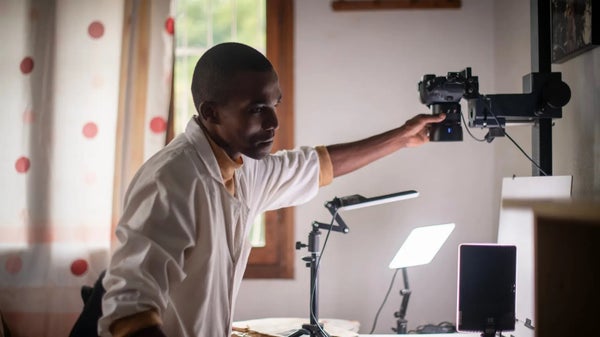
Digital specimens from one of the world’s largest collections of plant and fungi are being made available to researchers from all over the world, free of charge.
The Royal Botanic Gardens at Kew in southwest London announced on 16 June that it has completed the digitization of 7.4 million specimens. The project, which used four high-resolution cameras operated by 100 staff and 42 volunteers, cost £15 million (US$20 million) and was funded by the UK government.
On the same day, Kew also released its 2026 State of the World’s Plants and Fungi report, highlighting how digitization and artificial intelligence (AI) can transform plant and fungi science.
On supporting science journalism
If you're enjoying this article, consider supporting our award-winning journalism by subscribing. By purchasing a subscription you are helping to ensure the future of impactful stories about the discoveries and ideas shaping our world today.
Kew is making its full digital collection available on its website, which will also be searchable via the Global Biodiversity Information Facility, a portal to natural-history collections around the world. Kew’s executive director of science, Alexandre Antonelli, says that the digitization project will help to democratize access to its resources by making them available to researchers worldwide.
“In this four-year project, every cupboard and every box has been opened,” says Kew botanist Sarah Phillips, who led the digitization project. Digital pictures capture not only the pressed specimens, but also labelling that contains crucial information about where, when and by whom they were collected.
While Kew and London’s Natural History Museum have been relatively early adopters of digitization, millions of botanical, mycological and zoological samples lie underused at dozens of smaller institutions around the United Kingdom. The UK government has recently kickstarted a ten-year, £155.6-million project called Distributed System of Scientific Collections UK (DISSCO-UK) to help those collections come online, too.
Research led by economist Helen Hardy, then at the Natural History Museum, has found that by digitizing natural-history collections could add up to £2 billion to the UK economy. “We are at a moment in time where digitization is more efficient and effective than before,” Hardy says.
Extinction abyss
The State of the World’s Plants and Fungi was unveiled together with 52 peer-reviewed papers published in the journals Plants People Planet and New Phytologist.
According to the report, 400,000 plant species have been scientifically described, and that there are perhaps an additional 100,000 that are yet to be discovered.

Of the ones known to science, 29,748 are classified as at risk of extinction. Fewer than 1,000 have been formally declared extinct, but the true number could be much larger, the report concludes. Fungi are sometimes described as the ‘dark matter’ of biology — there are about 205,000 classified species but there could be millions more, said Ester Gaya, Kew’s lead mycologist, at a briefing for reporters on 15 June.
In the three years between 2020 and 2023, some 18,000 new plants and fungi had been described, according to the previous State of the World’s Plants and Fungi report. But the report also revealed that the majority of these new discoveries are also at a higher level of extinction risk. “Taxonomy is now effectively in a race against extinction”, according to a Kew statement.
Among the developments highlighted in the latest report is the reversal of practices that had begun during the centuries of colonial rule. Whereas the countries of Europe or North America used to hold most herbarium type specimens — the ones biologists use when first scientifically describing a plant — the majority are now in the countries or regions where they were discovered, according to the report.
AI to the rescue!
The report also highlights how AI tools have become invaluable both in the field and at museums around the world. Image recognition, in particular, can speed up the identification of a species — or whether the species is new to science — and track whether its range and populations are shrinking or shifting geographically.
“We can use digital assets, AI and other technologies to harness the information locked in specimens that have been here for centuries,” Antonelli said at the briefing for reporters.
Kew also says that “digitization and mathematical models can significantly help speed up the naming of new species and extinction assessments.”
It’s 250 years of material with different forms of handwriting, and it’s very inconsistent,” says Kew botanist Alan Paton. AI could now be instrumental in extracting more information from the scans of the often-handwritten labels.”
This article is reproduced with permission and was first published on June 15, 2026.